Nvidia and Antoine Arnault Are Betting on Virtual Try-On — Here's What RealFit Could Change
At the Nvidia GTC conference, the AI chip giant announced a partnership with Catches to launch RealFit, a physics-based virtual try-on platform backed by Ant...
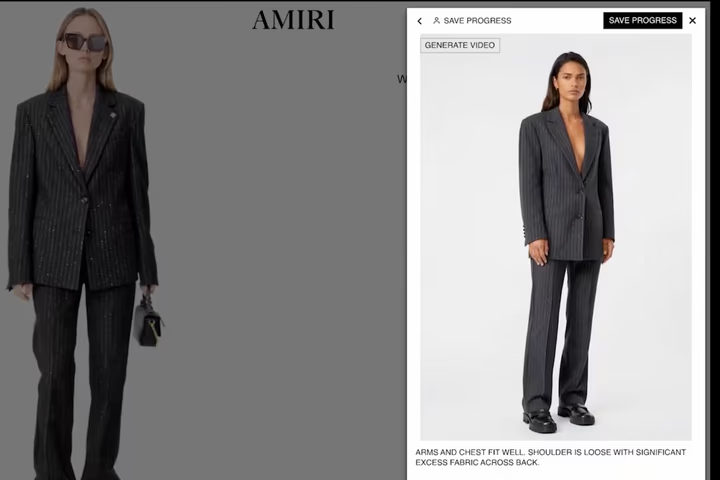
At the Nvidia GTC conference, the AI chip giant announced a partnership with Catches to launch RealFit, a physics-based virtual try-on platform backed by Antoine Arnault. The technology could mark a turning point for digital fashion retail. Nvidia and Antoine Arnault are backing RealFit, a new virtual try-on platform that uses physics simulation to deliver more realistic digital fitting experiences. (Nvidia/Catches)
Introduction
Virtual try-on has been one of fashion technology's most persistent promises — and most persistent disappointments. For years, the pitch has been compelling: let shoppers see how clothes will look on their own bodies before they buy, reduce return rates, and bridge the gap between the digital and physical shopping experience. The execution, however, has consistently fallen short. Avatars that don't look like real people, fabric simulations that ignore how materials actually drape and move, and interfaces clunky enough to deter all but the most determined shoppers have kept virtual try-on firmly in the "interesting but not quite there" category.
That may be changing. At the Nvidia GTC conference in March 2026, Nvidia announced a partnership with Catches — a fashion technology startup backed by Antoine Arnault, scion of the LVMH dynasty — to launch RealFit, a new virtual try-on platform that takes a fundamentally different approach to the problem. By applying physics simulation to digital garment rendering, RealFit aims to produce try-on experiences that are genuinely realistic — not just visually plausible, but physically accurate.
The involvement of both Nvidia, the world's leading AI chip company, and Antoine Arnault, one of luxury fashion's most influential next-generation figures, signals that this is not another incremental improvement on existing technology. It's a serious bet that virtual try-on is finally ready to become a mainstream retail tool.
What Is RealFit and How Does It Work?
RealFit is a virtual try-on platform built on physics-based simulation technology. Unlike most existing virtual try-on tools, which use image-based AI to overlay garment images onto photos of shoppers, RealFit models how fabrics actually behave — how they stretch, drape, fold, and respond to body movement.
The distinction matters enormously in practice. A silk blouse behaves very differently from a structured blazer. Denim has different physical properties from jersey knit. A garment that fits well on a size 6 body will fit differently on a size 14 body, and those differences are not just about scale — they involve changes in how the fabric moves and sits. Physics-based simulation can capture these nuances in a way that image-overlay approaches fundamentally cannot.
Nvidia's role in the platform is to provide the computational infrastructure that makes real-time physics simulation possible at consumer scale. Running accurate physics models for fabric behavior is computationally intensive — it's the kind of problem that has historically required specialized hardware and significant processing time. Nvidia's GPU technology, increasingly optimized for AI and simulation workloads, makes it possible to run these simulations fast enough to be useful in a retail context.
Catches, the startup behind RealFit, brings the fashion-specific expertise: understanding how garments are constructed, how sizing works across different brands and categories, and what the actual pain points are for both shoppers and retailers in the try-on experience.
Why Antoine Arnault's Involvement Matters
Antoine Arnault is not a passive investor in fashion technology. As the head of communications and image for LVMH and a board member of several LVMH houses, he has direct influence over how some of the world's most valuable luxury brands approach technology adoption. His backing of Catches and RealFit sends a clear signal about where he believes digital retail is heading — and potentially about where LVMH brands might go.
This is significant for several reasons. LVMH's portfolio includes brands — Louis Vuitton, Dior, Givenchy, Loewe, and many others — that have historically been cautious about digital innovation, particularly in areas that touch the customer experience. The luxury house's relationship with e-commerce has been complicated; many of its brands were slow to embrace online retail, and some have actively resisted it in order to protect the exclusivity of the in-store experience.
Virtual try-on, done well, could change that calculus. If RealFit can deliver a digital try-on experience that is genuinely accurate and genuinely useful — that actually helps luxury shoppers make confident purchase decisions online — it could open up new possibilities for luxury e-commerce without compromising the quality standards that luxury brands demand.
The Arnault connection also brings credibility with the luxury industry more broadly. Fashion technology startups often struggle to get serious attention from heritage luxury houses, which tend to be skeptical of Silicon Valley solutions to fashion problems. A platform backed by a member of the Arnault family carries a different kind of authority.
The Problem Virtual Try-On Has Always Had
To understand why RealFit's physics-based approach is significant, it helps to understand why previous virtual try-on solutions have struggled to gain traction.
The realism gap. Most virtual try-on tools produce results that look plausible in a screenshot but feel unconvincing in use. Fabrics don't move right. Shadows are wrong. The garment sits on the body in a way that doesn't quite match how it would in real life. These small inaccuracies add up to an experience that shoppers don't trust — and an experience they don't trust won't change their purchasing behavior.
The body diversity problem. Virtual try-on tools have historically performed much better on standardized body types than on the full range of human bodies. This is both a technical problem — it's harder to model how garments fit on a wider range of body shapes — and a data problem, since most training datasets have historically underrepresented diverse body types.
The integration challenge. Even when the technology works well, integrating it into existing e-commerce platforms in a way that's seamless and intuitive for shoppers has proven difficult. A try-on tool that requires shoppers to upload multiple photos, wait for processing, and navigate a clunky interface will be used by very few people, regardless of how accurate the results are.
The brand quality bar. For luxury brands in particular, the quality bar for any customer-facing technology is extremely high. A virtual try-on experience that looks cheap or feels generic is worse than no try-on experience at all — it actively undermines the brand's premium positioning.
Physics-based simulation addresses the first problem directly and has the potential to address the others as well, particularly as the underlying technology improves and as more data becomes available to train and refine the models.
What This Means for Fashion E-Commerce
If RealFit delivers on its promise, the implications for fashion e-commerce are substantial.
Reduced return rates. Returns are one of the biggest cost and sustainability challenges in fashion e-commerce. A significant proportion of returns are driven by fit issues — the item doesn't look or fit the way the shopper expected. Accurate virtual try-on could meaningfully reduce that proportion, with significant benefits for both retailers and the environment.
Increased conversion rates. Shoppers who can try before they buy — even digitally — are more likely to complete a purchase. The confidence that comes from seeing how a garment will actually look and fit on your body reduces the hesitation that causes cart abandonment.
New possibilities for luxury e-commerce. For luxury brands that have been reluctant to fully embrace online retail, a genuinely high-quality virtual try-on experience could provide the missing piece — a way to deliver something approaching the quality of an in-store experience in a digital context.
Democratized access to fashion. Virtual try-on also has the potential to make fashion more accessible to shoppers who face barriers to in-store shopping — whether due to geography, disability, time constraints, or social anxiety. The ability to try on clothes from home, accurately and conveniently, could expand the market for fashion brands in meaningful ways.
Practical Tips for Retailers Evaluating Virtual Try-On Technology
- Prioritize accuracy over novelty. The most important metric for virtual try-on is whether shoppers trust the results enough to change their purchasing behavior. A technically impressive demo that doesn't translate to real-world accuracy is not useful.
- Test across diverse body types. Any virtual try-on solution you evaluate should be tested on a representative range of body shapes and sizes. Solutions that only work well on standardized body types will alienate a significant portion of your customer base.
- Measure impact on returns and conversion. Set clear KPIs before deployment and track them rigorously. The business case for virtual try-on depends on demonstrable impact on these metrics.
- Consider the brand experience. For premium and luxury brands, the quality of the virtual try-on experience must be consistent with the overall brand standard. A low-quality implementation can do more harm than good.
- Plan for integration. Virtual try-on technology is only valuable if shoppers actually use it. Invest in seamless integration with your e-commerce platform and intuitive UX design.
Conclusion
The launch of RealFit at Nvidia GTC represents a meaningful step forward in virtual try-on technology — and the involvement of both Nvidia and Antoine Arnault suggests that the industry's most serious players are taking this step seriously. Physics-based simulation addresses the fundamental realism problem that has held virtual try-on back, and the computational infrastructure to run it at scale is now available.
Whether RealFit succeeds will depend on execution: on whether the physics models are accurate enough, the body diversity broad enough, and the integration smooth enough to actually change how shoppers behave. But the ambition is clear, and the backing is credible. Virtual try-on's long-promised moment may finally be arriving.
FAQ
Q: What makes physics-based virtual try-on different from existing solutions? Physics-based virtual try-on models how fabrics actually behave — how they drape, stretch, fold, and respond to body movement — rather than simply overlaying garment images onto photos. This produces significantly more realistic results, particularly for garments with complex fabric behavior like silk, knitwear, or structured tailoring.
Q: Who is Antoine Arnault and why does his involvement matter? Antoine Arnault is the head of communications and image for LVMH, the world's largest luxury conglomerate, and a board member of several LVMH houses. His backing of Catches and RealFit signals both personal conviction in the technology and potential pathways for adoption within the LVMH portfolio, which includes Louis Vuitton, Dior, and dozens of other luxury brands.
Q: Can virtual try-on actually reduce fashion return rates? Evidence from existing virtual try-on deployments suggests yes, though the magnitude of the effect varies significantly depending on the quality of the technology and how well it's integrated into the shopping experience. Physics-based solutions that produce more accurate results are expected to have a larger impact on returns than image-overlay approaches.
Q: When will RealFit be available to retailers? The platform was announced at Nvidia GTC in March 2026. Specific timelines for broader retail availability had not been publicly confirmed at the time of the announcement. Brands interested in the platform should contact Catches directly for current availability information.
Q: Is virtual try-on suitable for luxury brands? With the right technology and implementation, yes. The key requirements for luxury brands are a level of visual quality and realism consistent with their brand standards, and an integration that feels seamless and premium rather than clunky or generic. Physics-based solutions like RealFit are better positioned to meet the luxury quality bar than earlier-generation image-overlay tools.
Continue reading

12 Grandparent-and-Grandchild Photo Poses
May 24, 2026
42 Free Photography Books to Download (PDF + eBooks)
May 24, 2026
How to Edit Concert Photos for Best Results
July 11, 2026
AI-Generated Mockups Are Going Viral — But Are They Good for Fashion Brands?
May 24, 2026
13 Unique Father's Day Gifts That Go Way Beyond the Usual Mug
May 24, 2026
Working With Roxanne Lowit, the Queen of Backstage Photography
September 27, 2026
A Day by Boat: How to Dress, What to Bring, and Why It's the Ultimate Summer Experience ⛵️
May 24, 2026
Everything to Know About Wedding Photography Styles
September 27, 2026
Fashion's Top Executives Gather in London to Explore AI's Role in the Industry
May 24, 2026
Ryan McGinley's Top Tips for Taking Stylish Travel Photos
September 27, 2026
61 Best Photography Books for All Levels
September 25, 2026
Casual Going Out Fit: How Luxury Streetwear Is Redefining After-Dark Dressing
May 25, 2026
How to Pose and Photograph Shy, Difficult, or Anxious Pets
September 25, 2026
How to Photograph Children: 29 Tips for Creative and Fun Photos
May 24, 2026
The 4 Best Ways to Digitize Old Photos (and How to Store Them)
May 24, 2026