Fashion's Top Executives Gather in London to Explore AI's Role in the Industry
Senior leaders from Bottega Veneta, Harrods, Bvlgari, Selfridges, Manolo Blahnik, Tiffany & Co., and more came together at The Roof Gardens in London for an...
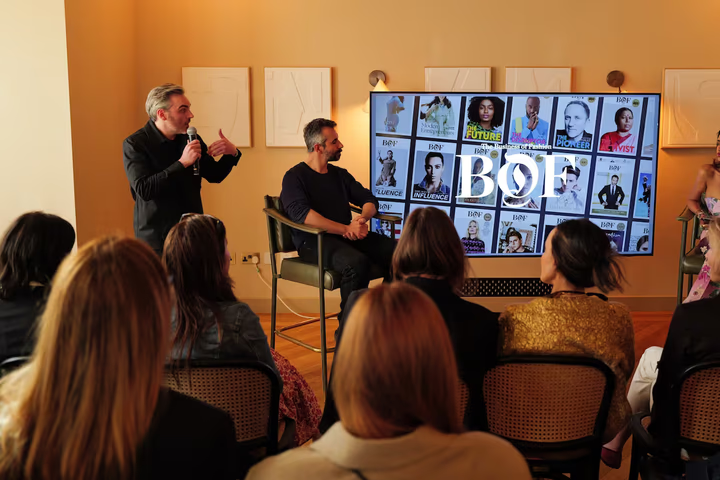
Senior leaders from Bottega Veneta, Harrods, Bvlgari, Selfridges, Manolo Blahnik, Tiffany & Co., and more came together at The Roof Gardens in London for an exclusive evening of conversation about artificial intelligence in fashion and beauty. Senior industry leaders gathered at The Roof Gardens in London for an exclusive AI insights briefing hosted by The Business of Fashion.
Introduction
As artificial intelligence moves from buzzword to business imperative, the fashion and luxury industries are grappling with a fundamental question: how do you integrate transformative technology into an industry built on human creativity, craftsmanship, and emotional connection?
That question was at the center of an exclusive gathering hosted by The Business of Fashion at The Roof Gardens in London. Senior executives from some of the world's most recognized luxury and retail brands came together for an intimate aperitivo evening to share insights, exchange perspectives, and explore what AI actually means for their businesses — not in theory, but in practice.
Who Was in the Room
The guest list read like a who's who of fashion and luxury leadership. Attendees included senior figures from Bottega Veneta, Harrods, Bvlgari, Selfridges, Manolo Blahnik, and Tiffany & Co., among others — a cross-section of the industry spanning heritage luxury houses, iconic department stores, and specialty retailers.
The intimate format was deliberate. Rather than a large conference with formal presentations, the evening was designed to facilitate genuine conversation — the kind of candid, peer-to-peer exchange that rarely happens in public forums. With executives from both the brand and retail sides of the industry in the same room, the discussion naturally spanned the full spectrum of AI's potential impact, from product development and marketing to customer experience and operations.
The Central Questions Facing the Industry
While the specific details of the evening's conversations remain private, the themes that brought these executives together reflect the broader questions the industry is wrestling with right now.
How do you use AI without losing what makes your brand special? For luxury brands in particular, the fear is that AI-driven efficiency will come at the cost of the human touch that defines their value proposition. Consumers pay premium prices for products and experiences that feel personal, considered, and crafted. Any AI application that makes a brand feel generic or automated risks undermining that perception.
Where does AI add genuine value versus where does it create risk? Not all AI applications are equal. Using machine learning to optimize inventory management or predict demand is very different from using generative AI to create marketing imagery or design new products. Executives are increasingly focused on identifying the specific use cases where AI delivers clear, measurable benefits — and being more cautious about applications where the risks outweigh the rewards.
How do you bring your organization along? Technology adoption is as much a people challenge as a technical one. Introducing AI into established creative and operational workflows requires change management, training, and a cultural shift. For organizations with deep traditions and strong creative identities, that process requires particular care.
What do consumers actually want? Growing evidence suggests that consumers — particularly luxury consumers — have complicated feelings about AI. They may appreciate AI-powered personalization and convenience, but they're often resistant to AI-generated creative content, which can feel inauthentic or at odds with the human artistry they associate with premium brands.
Why These Conversations Matter
Events like this one serve an important function in an industry that is simultaneously excited about AI's potential and anxious about its implications. When senior leaders from competing organizations can speak frankly with one another — off the record, in a relaxed setting — the quality of thinking that emerges is often more honest and more useful than what gets said in public.
The fashion and luxury industries have historically been slower than other sectors to adopt new technologies, often for good reasons. The emphasis on craft, heritage, and human creativity creates a natural tension with the efficiency-first logic of most technology adoption. But the pace of AI development is making that caution increasingly difficult to maintain. The question is no longer whether to engage with AI, but how to do so in a way that enhances rather than diminishes what makes these brands valuable.
Key Themes Emerging Across the Industry
Based on the broader conversation happening across fashion and luxury, several themes are consistently surfacing in executive discussions about AI:
Operational AI is moving faster than creative AI. Most brands are further along in deploying AI for back-end operations — supply chain, demand forecasting, customer service automation — than they are in using it for creative applications. The operational case is clearer and the risks are lower.
Data quality is the foundation. AI is only as good as the data it's trained on. Brands that have invested in clean, well-organized customer and product data are better positioned to benefit from AI than those that haven't.
The human-AI collaboration model is emerging as the preferred approach. Rather than replacing human creativity with AI, leading brands are exploring how AI can augment and accelerate human work — handling repetitive tasks, generating options for human editors to refine, and freeing up creative talent to focus on higher-value work.
Transparency with consumers is becoming a competitive differentiator. As consumers grow more sophisticated about AI, brands that are honest about how and where they use it are building trust. Those that try to obscure AI involvement risk backlash when it's discovered.
Practical Takeaways for Fashion Executives
- Start with clear use cases. Don't adopt AI for its own sake. Identify specific problems or opportunities where AI can deliver measurable value.
- Invest in data infrastructure first. The quality of your AI outputs depends entirely on the quality of your data inputs.
- Protect your creative identity. Establish clear guidelines about where AI can and cannot be used in your creative process, and communicate those guidelines internally.
- Engage your teams early. AI adoption succeeds when employees understand the "why" and are involved in the "how." Top-down mandates without adequate training and communication tend to fail.
- Watch consumer sentiment closely. Attitudes toward AI in fashion are evolving rapidly. What consumers accept today may not be what they accept tomorrow.
Conclusion
The gathering at The Roof Gardens was a reminder that the most important conversations about AI in fashion aren't happening on conference stages or in press releases — they're happening in rooms like this one, where senior leaders can speak honestly about what they're seeing, what they're worried about, and what they're actually doing.
As AI continues to reshape the industry, these peer-to-peer exchanges will become increasingly valuable. The brands that navigate the AI transition most successfully will be those whose leaders are actively engaged in this kind of informed, nuanced conversation — not just following the headlines, but shaping the thinking.
FAQ
Q: How are luxury brands using AI differently from mass-market fashion brands? Luxury brands tend to be more cautious about AI applications that touch the customer experience or creative output, given the premium they place on human artistry and exclusivity. They're generally more advanced in operational AI (supply chain, demand forecasting) than in consumer-facing applications. Mass-market brands have been quicker to deploy AI in areas like personalization, virtual try-on, and customer service automation.
Q: What's the biggest risk of AI adoption for luxury brands? The biggest risk is undermining the perception of human craftsmanship and creative vision that justifies luxury pricing. If consumers start to feel that a brand's products or communications are AI-generated rather than human-crafted, it can erode the brand's premium positioning. Managing this perception requires careful communication and clear boundaries around AI use.
Q: Are fashion executives generally optimistic or pessimistic about AI? Most senior executives are cautiously optimistic — they see genuine potential in AI for improving efficiency and enabling new capabilities, but they're also aware of the risks and the complexity of implementation. The mood in the industry has shifted from "should we use AI?" to "how do we use it well?"
Q: How is AI changing the role of creative directors and designers in fashion? AI is increasingly being used as a tool to augment creative work rather than replace it — generating options, accelerating iteration, and handling repetitive tasks. Most creative leaders see AI as a powerful assistant rather than a threat, though there are legitimate concerns about the long-term impact on entry-level creative roles.
Q: What does "responsible AI" look like in the fashion industry? Responsible AI in fashion involves transparency about where and how AI is used, ensuring that AI applications don't perpetuate bias (particularly in areas like model casting and customer targeting), protecting employee privacy and job security, and maintaining the human creative standards that define brand identity.
Continue reading
42 Free Photography Books to Download (PDF + eBooks)
May 24, 2026
Working With Roxanne Lowit, the Queen of Backstage Photography
September 27, 2026
9 Steps to Finding the Perfect Wedding Photographer
September 27, 2026
Instagram Stars Share Their Secrets to Taking Amazing Photos
September 27, 2026
Which Fashion Brands Are Winning the AI Discovery Battle — And Why It Matters More Than SEO
May 24, 2026
6 Chic Sandal Trends That Will Give Your Summer Shoe Collection Some Personality
May 24, 2026
A Day by Boat: How to Dress, What to Bring, and Why It's the Ultimate Summer Experience ⛵️
May 24, 2026
How to Photograph Children: 29 Tips for Creative and Fun Photos
May 24, 2026
8 Sibling Rivalry Poses That Turn Fights Into Epic Photoshoots
July 11, 2026
Casual Going Out Fit: How Luxury Streetwear Is Redefining After-Dark Dressing
May 25, 2026
A French Woman Walks Into Nordstrom — 33 Items She's Buying From the Half-Yearly Sale
May 24, 2026
27 Flattering Portrait Poses
September 25, 2026
99 Most Inspirational Photography Quotes
September 25, 2026
How to Fix Bad Lighting in Photos on iPhone, Lightroom, and Photoshop
May 24, 2026
Making Money with Stock Photography
September 25, 2026