Why Fashion Stays Silent About Its AI Use — And Why That Silence Is Becoming a Problem
A new analysis reveals that most major fashion and retail players are already using AI across their operations. So why are so many of them reluctant to talk...
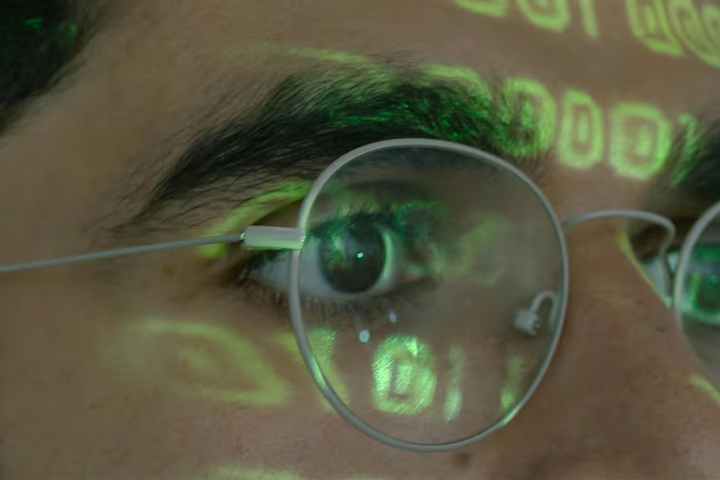
A new analysis reveals that most major fashion and retail players are already using AI across their operations. So why are so many of them reluctant to talk about it publicly? Despite widespread AI adoption across fashion and retail, many brands remain reluctant to discuss their use of the technology publicly. (Getty Images)
Introduction
Ask most major fashion brands whether they use artificial intelligence, and you're likely to get one of two responses: a carefully worded non-answer about "exploring innovative technologies," or silence. Yet behind the scenes, AI is already deeply embedded in how these companies operate — from the algorithms that decide which products get promoted on their websites to the machine learning models that forecast demand and optimize inventory.
A new analysis of AI adoption across the fashion and retail sector confirms what many industry insiders already suspected: the gap between what brands are doing with AI and what they're willing to say about it publicly is significant and growing. Most big players are using AI. Most of them don't want to talk about it.
Understanding why — and why that silence is increasingly untenable — is one of the more important questions facing fashion's leadership right now.
The Extent of AI Adoption in Fashion and Retail
The analysis paints a picture of an industry that has moved well past the "exploring AI" phase and into active deployment across a wide range of functions.
Demand forecasting and inventory management are among the most widespread applications. AI-powered systems can analyze sales data, seasonal patterns, external signals like weather and social media trends, and a host of other variables to predict what products will sell, in what quantities, and where. For an industry that has historically struggled with overproduction and markdowns, these capabilities represent significant operational value.
Personalization is another area of deep AI penetration. The recommendation engines that power "you might also like" features on fashion e-commerce sites, the algorithms that determine which products appear first in search results, and the systems that decide which email campaigns to send to which customers are all AI-driven. Most major fashion retailers have been running some form of AI-powered personalization for years.
Customer service automation — chatbots, automated email responses, AI-powered FAQ systems — is widespread, particularly among larger retailers with high volumes of customer inquiries. Supply chain optimization, fraud detection, pricing algorithms, and visual search are also common applications.
On the creative side, AI adoption is more recent and more uneven. Generative AI tools are being used for tasks ranging from product description writing to trend forecasting to the generation of marketing imagery. But this is where the sensitivity is highest — and where the silence is most pronounced.
Why Brands Don't Want to Talk About It
The reluctance to discuss AI use publicly is driven by several distinct concerns, each of which reflects a genuine tension that brands are navigating.
Fear of consumer backlash. As documented extensively in the growing literature on AI sentiment, consumers — particularly luxury consumers — can react negatively to the revelation that AI is involved in the products or experiences they value. Brands that have invested years in building narratives of human craftsmanship and creative vision are understandably cautious about anything that might complicate those narratives.
Competitive sensitivity. AI capabilities in areas like demand forecasting, pricing, and personalization can represent genuine competitive advantages. Brands that have invested significantly in these capabilities may be reluctant to disclose them, for the same reason they wouldn't disclose other proprietary operational methods.
Regulatory uncertainty. The regulatory landscape around AI is evolving rapidly, particularly in the EU, where the AI Act is introducing new requirements for transparency and accountability in AI systems. Brands operating across multiple jurisdictions are navigating a complex and still-developing set of rules, and some are choosing silence over premature disclosure.
Internal uncertainty. In many organizations, AI adoption has happened faster than governance frameworks have developed. Brands may be using AI in ways that haven't been fully reviewed by legal, compliance, or communications teams — and they're not ready to discuss publicly what they haven't fully worked out internally.
The "AI washing" backlash. The fashion industry has seen its share of brands that overclaimed AI capabilities in ways that turned out to be misleading or exaggerated. The resulting skepticism — from journalists, investors, and consumers — has made some brands more cautious about making any AI claims at all, even accurate ones.
The Specific Silence Around Creative AI
The most pronounced silence in fashion's AI conversation is around creative applications — the use of AI in design, campaign production, and marketing content. This is where the stakes feel highest, and where the gap between private practice and public communication is widest.
Several major fashion brands are known to be experimenting with generative AI for tasks like trend forecasting, colorway development, and the generation of marketing imagery. Some are using AI to produce product descriptions at scale. A few are exploring AI-assisted design tools that can generate pattern variations or suggest silhouette modifications based on historical sales data.
But almost none of these brands are talking about it publicly. The concern is straightforward: in an industry where creative vision is the primary source of value, admitting that AI is involved in the creative process risks undermining the very thing that justifies the brand's premium.
This creates a peculiar situation where the industry is simultaneously moving rapidly toward AI-assisted creativity and maintaining a public posture of human-only creative processes. The gap between those two realities is not sustainable — and as AI tools become more capable and more widely used, it will become increasingly difficult to maintain.
The Cost of Silence
The reluctance to discuss AI use publicly is understandable, but it comes with real costs that brands are beginning to feel.
Trust erosion when the truth emerges. Consumers and journalists are becoming increasingly sophisticated at identifying AI-generated content and AI-assisted processes. When brands that have been silent about their AI use are "outed" — by investigative journalism, by disgruntled employees, or simply by the growing visibility of AI tools — the resulting trust damage can be significant. The cover-up, in this context, can be worse than the crime.
Missed opportunity to shape the narrative. Brands that are proactive about discussing their AI use have the opportunity to frame that use in positive terms — as a tool for efficiency, sustainability, or enhanced customer experience. Brands that stay silent cede that narrative to others, including critics and competitors.
Talent and partnership challenges. The best AI talent — the engineers, data scientists, and AI specialists that fashion companies need to build competitive capabilities — wants to work on interesting, visible problems. Brands that can't talk about their AI work publicly may struggle to attract and retain the talent they need.
Regulatory risk. As AI transparency requirements develop, particularly in the EU, brands that have not developed clear internal governance and communication frameworks around AI use may find themselves scrambling to comply. Early movers on transparency will be better positioned.
Investor relations complications. Investors are increasingly asking about AI strategy and AI risk. Brands that can't articulate a clear, honest answer to those questions may face skepticism from the investment community.
What Responsible AI Transparency Looks Like
The solution to fashion's AI silence is not blanket disclosure of every AI application — some competitive sensitivity is legitimate, and not every operational AI tool requires public announcement. The solution is a principled, proactive approach to AI transparency that builds trust rather than eroding it.
Distinguish between operational and creative AI. Brands can reasonably be more open about operational AI applications (demand forecasting, logistics, customer service) than about creative AI applications, where competitive sensitivity is higher. But even on the creative side, a general statement of principles — "we use AI as a tool to support our human creative teams, never to replace them" — is better than silence.
Develop a clear AI communication policy. Decide, at the leadership level, what the brand will and won't disclose about AI use, and ensure that policy is consistently applied across all communications channels.
Be proactive rather than reactive. Don't wait for a journalist or a consumer to ask. Develop a clear, honest narrative about the brand's AI use and communicate it proactively through appropriate channels.
Align internal and external messaging. One of the most common sources of AI communication problems is a gap between what employees know and what the brand says publicly. Ensure that internal and external messaging are consistent.
Engage with the regulatory process. As AI transparency requirements develop, brands that have been actively engaged in the regulatory conversation will be better positioned to comply — and to influence the rules in ways that work for the industry.
Practical Tips for Fashion Brands Developing an AI Communication Strategy
- Conduct an AI audit. Before you can communicate about your AI use, you need to know exactly what you're using, where, and for what purpose. Many brands discover gaps in their own knowledge when they do this exercise.
- Categorize your AI applications by sensitivity. Not all AI applications carry the same communication risk. Develop a tiered approach that distinguishes between what you're comfortable disclosing, what requires more careful framing, and what you're not ready to discuss publicly.
- Prepare for the question. Train your communications and PR teams to handle AI-related questions from journalists, consumers, and investors. Having a clear, consistent answer ready is far better than being caught unprepared.
- Monitor the regulatory landscape. Keep track of AI transparency requirements in the markets where you operate, particularly the EU AI Act and any national-level requirements that may apply.
- Build internal AI governance first. External communication about AI use is only credible if it's backed by genuine internal governance. Invest in AI ethics frameworks, review processes, and accountability structures before making public claims.
Conclusion
Fashion's silence about AI is a short-term strategy with long-term costs. As AI adoption deepens and as consumer, regulatory, and investor scrutiny intensifies, the gap between what brands are doing and what they're saying will become increasingly difficult to sustain.
The brands that navigate this moment most successfully will be those that develop principled, proactive approaches to AI transparency — that find ways to talk honestly about their AI use in terms that build rather than erode trust. That requires courage, clarity, and a willingness to engage with a conversation that much of the industry has been avoiding. But the alternative — continued silence in the face of growing scrutiny — is not a viable long-term position.
FAQ
Q: Are most fashion brands really using AI already? Yes. Analysis of the sector suggests that the majority of major fashion and retail companies are using AI in some form, most commonly in demand forecasting, inventory management, personalization, and customer service. Creative AI applications are less universal but growing rapidly.
Q: Why are fashion brands so reluctant to talk about AI? The reluctance stems from multiple concerns: fear of consumer backlash, competitive sensitivity, regulatory uncertainty, internal governance gaps, and the risk of being associated with "AI washing." The combination of these factors has created a culture of silence that is becoming increasingly difficult to maintain.
Q: Is it legally required for fashion brands to disclose AI use? Requirements vary by jurisdiction and application. The EU AI Act introduces transparency requirements for certain categories of AI systems, particularly those that interact with consumers. Brands operating in the EU should consult legal counsel about their specific obligations. In most other markets, disclosure requirements are currently limited, though this is evolving.
Q: How can consumers find out if a brand is using AI? Currently, there is no reliable way for consumers to know exactly how a brand uses AI unless the brand discloses it. Investigative journalism, employee disclosures, and the visual characteristics of AI-generated content are the most common ways AI use becomes public. This is likely to change as transparency requirements develop.
Q: What's the difference between legitimate AI use and "AI washing"? AI washing refers to brands that overclaim or misrepresent their AI capabilities — for example, describing a simple rules-based system as "AI-powered" or claiming AI-driven sustainability improvements that don't actually exist. Legitimate AI use involves genuine deployment of AI technologies for stated purposes, with honest communication about what those technologies do and don't do.
Continue reading

61 Best Photography Books for All Levels
September 25, 2026
How to Fix Bad Lighting in Photos on iPhone, Lightroom, and Photoshop
May 24, 2026
Master Flow Posing Photography: 9 Dynamic Techniques
July 11, 2026
Family Photoshoot Poses
September 25, 2026
Afterparty Style: Why Custom Clothing Is the Ultimate Expression of Personal Identity
May 25, 2026
How to Photograph Children
September 25, 2026
13 Unique Father's Day Gifts That Go Way Beyond the Usual Mug
May 24, 2026
How to Take the Perfect Engagement Photos: The 5 Rules
September 27, 2026
9 Steps to Finding the Perfect Wedding Photographer
September 27, 2026
Is AI Antithetical to Luxury? What Prada's Controversial Campaign Reveals About Fashion's Biggest Tension
May 24, 2026
Which Fashion Brands Are Winning the AI Discovery Battle — And Why It Matters More Than SEO
May 24, 2026
27 Flattering Portrait Poses
September 25, 2026
6 Chic Sandal Trends That Will Give Your Summer Shoe Collection Some Personality
May 24, 2026
Working With Roxanne Lowit, the Queen of Backstage Photography
September 27, 2026
Nvidia and Antoine Arnault Are Betting on Virtual Try-On — Here's What RealFit Could Change
May 24, 2026