How AI Is Improving Digital Cameras
When photographers talk about AI, the conversation usually focuses on post-processing — background removal, image generation, automatic editing. But AI's mos...
When photographers talk about AI, the conversation usually focuses on post-processing — background removal, image generation, automatic editing. But AI's most transformative impact on photography is happening much earlier in the process: inside the camera itself. From autofocus to noise reduction to in-camera scene recognition, artificial intelligence is quietly rewriting what a camera can do.
AI-Powered Autofocus
Autofocus is the most visible and immediately practical application of AI in modern cameras. Traditional contrast-detection autofocus worked by detecting edges — it had no understanding of what it was looking at. AI-powered autofocus goes further: it recognizes what the subject actually is.
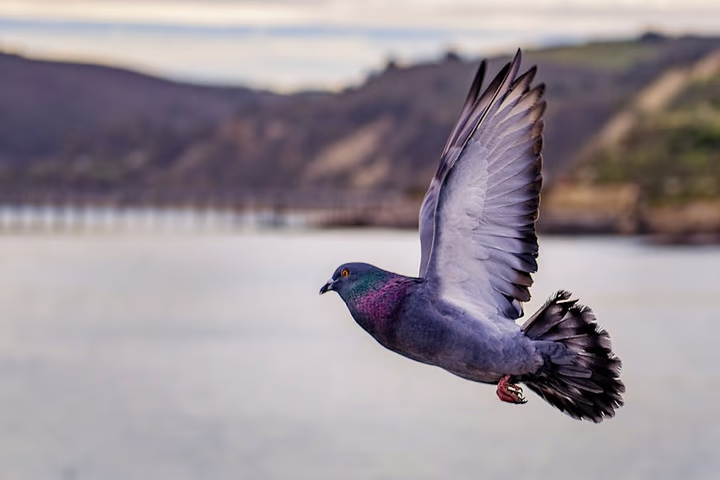
When a camera can identify a bird, a racing car, or a human eye, it can also predict how that subject moves and track it with far greater accuracy. This is why modern mirrorless cameras from Sony, Canon, and Nikon can maintain lock on a bird in flight through a cluttered forest background, or keep a child's eye sharp as they sprint toward the camera.
The improvement is especially dramatic in low light. Traditional autofocus systems struggled in dim conditions because there wasn't enough contrast to detect edges. AI systems recognize shapes and patterns even in near-darkness, dramatically improving the keeper rate in challenging environments.
Leading cameras: Sony Alpha series (Real-time Tracking), Canon R-series (Deep Learning AF), Nikon Z-series (3D Tracking).
Subject and Scene Recognition
AI enables cameras to distinguish between different types of subjects — people, animals, vehicles, birds, insects — and apply different tracking behaviors for each. Sony's high-end mirrorless bodies can even detect and track insects in flight. Fujifilm's X-H2S recognizes motorcycles, birds, and drones as distinct targets.
Scene recognition takes this further. Cameras can now identify "backlit portrait at sunset" or "fast-moving sports under artificial light" and adjust exposure, color, and focus behavior accordingly. This is not the same as the old "scene mode" dial — it is contextual, real-time analysis that adapts dynamically as conditions change.
AI Noise Reduction
Previous-generation in-camera noise reduction was a blunt instrument: it smoothed noise but also destroyed fine detail like hair texture, fabric weave, and skin pores. AI noise reduction is fundamentally different. It distinguishes between image detail and random sensor noise at the pixel level, cleaning up grain while preserving the textures that make an image feel sharp and real.
Sony's real-time processing keeps fine structure intact at ISOs that would have been unusable five years ago. Canon's system adapts to different noise profiles based on the specific shooting scenario. For photographers working in low light — concerts, events, wildlife at dusk — this is one of the most meaningful improvements in recent camera history.
Image Stabilization
AI has transformed image stabilization from reactive to predictive. Rather than simply counteracting shake after it occurs, modern systems analyze hand tremor patterns and counteract them before they affect the image. OM System cameras analyze the photographer's specific tremor signature and compensate accordingly. Sony and Nikon use AI to distinguish between intentional panning and accidental wobble, applying different correction strategies to each.
The practical result is that you can shoot handheld at shutter speeds that previously required a tripod, and panning shots no longer require manually switching stabilization modes.
Computational Photography
AI enables cameras to combine multiple exposures, sensor-shift data, and scene analysis to produce images that exceed what any single exposure could achieve. OM System cameras produce 50-megapixel files from a 20-megapixel sensor by combining multiple sensor-shifted frames. Panasonic offers computational ND filters that simulate long exposures without physical glass. Canon and Fujifilm use AI to blend HDR exposures that look natural rather than over-processed.
AI in Video
For video shooters, AI is delivering capabilities that previously required dedicated crew members. Sony's ZV-series cameras automatically reframe subjects for vertical social formats. Canon's R-series predicts subject movement for smooth focus pulls that previously needed a dedicated focus puller. AI stabilization distinguishes camera movement from hand shake, producing gimbal-smooth results from a handheld body.
Practical Takeaways
- Enable subject-detection modes and assign them to a custom button for fast switching between people, animals, and vehicles.
- Test your camera's AI noise reduction at ISOs you would normally avoid — the results may surprise you.
- Use AI stabilization's panning detection rather than manually switching modes. Modern systems handle the distinction automatically.
- Update your camera firmware regularly. AI features are often improved through firmware updates without any hardware change.
Final Thoughts
AI is not replacing the photographer's eye, timing, or creative vision. What it is doing is removing the technical friction that used to stand between a great moment and a sharp, well-exposed frame. The cameras of today are genuinely smarter than those of five years ago — and the pace of improvement shows no sign of slowing.
FAQ
Does AI autofocus work in very low light? Yes, and this is one of its biggest advantages over traditional contrast-detection systems. AI recognizes shapes and patterns even in near-darkness, maintaining focus where older systems would hunt or fail entirely.
Will AI features drain my camera battery faster? Modern AI processors are designed to run efficiently alongside the main image processor. Most photographers report negligible battery impact from AI features in normal shooting conditions.
Can I turn AI features off if I prefer manual control? Yes. All major manufacturers allow you to disable subject detection, scene recognition, and AI-assisted stabilization individually. Many experienced photographers use AI autofocus as a starting point and override it manually when needed.
Continue reading

How to Take the Perfect Engagement Photos: The 5 Rules
September 27, 2026
How to Photograph Shy, Difficult, or Anxious Pets
May 24, 2026
Making Money with Stock Photography
September 25, 2026
Ryan McGinley's Top Tips for Taking Stylish Travel Photos
September 27, 2026
Photographer Gray Malin's Travel Tips and the Art of the Aerial Beach Photograph
September 27, 2026
How Big Is a 4×6 Photo? Sizes in Inches, Centimeters, and Pixels
May 24, 2026
Sibling Photoshoot Poses
September 25, 2026
The 4 Best Ways to Digitize Old Photos (and How to Store Them)
May 24, 2026
Is AI Antithetical to Luxury? What Prada's Controversial Campaign Reveals About Fashion's Biggest Tension
May 24, 2026
How to Photograph Children: 29 Tips for Creative and Fun Photos
May 24, 2026
8 Sibling Rivalry Poses That Turn Fights Into Epic Photoshoots
July 11, 2026
How to Pose and Photograph Shy, Difficult, or Anxious Pets
September 25, 2026
42 Free Photography Books to Download (PDF + eBooks)
May 24, 2026
Afterparty Style: Why Custom Clothing Is the Ultimate Expression of Personal Identity
May 25, 2026
Nvidia and Antoine Arnault Are Betting on Virtual Try-On — Here's What RealFit Could Change
May 24, 2026