Is AI Antithetical to Luxury? What Prada's Controversial Campaign Reveals About Fashion's Biggest Tension
The reaction to Prada's unsettling Spring/Summer 2026 campaign has sparked a wider debate: can artificial intelligence and luxury fashion genuinely coexist —...
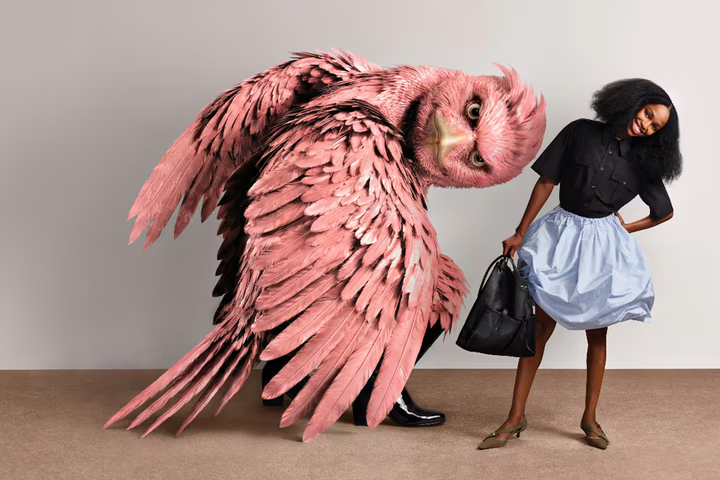
The reaction to Prada's unsettling Spring/Summer 2026 campaign has sparked a wider debate: can artificial intelligence and luxury fashion genuinely coexist — or are they fundamentally at odds? Prada's Spring/Summer 2026 campaign, featuring artwork by Jordan Wolfson. (Prada)
Introduction
When Prada released its Spring/Summer 2026 campaign, the internet did not respond with the usual mix of admiration and aspiration. Instead, the reaction was something closer to unease. The campaign — featuring artwork by artist Jordan Wolfson alongside the house's signature tailoring — struck many online viewers as deeply unsettling, and the conversation that followed quickly moved beyond the work itself into something more fundamental: is AI compatible with luxury at all?
The backlash to Prada's campaign, whether or not AI was directly involved in its creation, crystallized a sentiment that has been building quietly across fashion's most discerning audiences. For a growing segment of consumers, AI and luxury are not just different things — they are opposing things. And that perception, right or wrong, has real consequences for the brands navigating this moment.
This article explores what that reaction reveals, why the tension between AI and luxury runs so deep, and what it means for the future of high-end fashion in an AI-saturated world.
What Happened With Prada's Campaign
Prada's SS26 campaign was not, by most accounts, a straightforward AI-generated production. It featured real photography and the involvement of a recognized contemporary artist. But in the current climate, the line between "AI-influenced," "AI-assisted," and "AI-generated" has become blurred in the public imagination — and the campaign's uncanny, digitally-inflected aesthetic was enough to trigger the association.
Social media responses ranged from confused to actively hostile. Comments questioned whether the brand had "sold out" to technology, whether the images felt "human," and whether Prada — one of the most intellectually rigorous houses in fashion — had made a misstep by leaning into an aesthetic that felt more algorithmic than artisanal.
The fact that the campaign was misread, or at least ambiguously interpreted, is itself instructive. It suggests that luxury audiences are now primed to be suspicious of anything that feels even slightly "off" in the direction of AI. The threshold for triggering that suspicion is lower than it has ever been.
Why AI and Luxury Feel Incompatible to Many Consumers
The tension between AI and luxury is not arbitrary. It reflects a genuine conflict between what AI represents and what luxury has always promised.
Luxury is built on scarcity and human effort. The value of a handmade leather bag, a couture gown, or a hand-finished watch derives in large part from the time, skill, and human attention invested in its creation. AI, by its nature, is about scale, speed, and automation — the opposite of scarcity. When consumers sense AI in a luxury product or campaign, it can feel like a betrayal of the implicit contract they've entered into.
Luxury is built on authorship. A great luxury house is inseparable from the creative vision of its designers — the singular perspective of a Miuccia Prada, a Virgil Abloh, a Nicolas Ghesquière. AI-generated or AI-influenced work raises uncomfortable questions about authorship. If an algorithm contributed to the design, whose vision is it, really?
Luxury is built on emotional resonance. The best luxury campaigns don't just show products — they create worlds, tell stories, evoke feelings. That emotional depth is the product of human experience, human intuition, and human vulnerability. AI can approximate the surface qualities of emotional resonance, but many consumers feel — correctly or not — that something essential is missing.
Luxury is built on trust. Consumers who spend thousands of dollars on a luxury item are placing enormous trust in the brand. They're trusting that the product is what it claims to be, that the craftsmanship is genuine, that the brand's values are authentic. AI introduces uncertainty into that trust relationship in ways that brands are still learning to manage.
The Meta Factor: How Big Tech Is Complicating the Picture
The association between AI and luxury is also being shaped by the broader cultural context in which AI is being deployed. Meta — the company behind Facebook, Instagram, and the Ray-Ban smart glasses that are increasingly appearing in luxury retail contexts — has become one of the most prominent faces of AI in consumer culture.
Meta's aggressive AI rollout, including AI-generated profiles, AI-powered ad targeting, and AI features embedded throughout its platforms, has contributed to a general sense that AI is a tool of mass-market efficiency rather than premium craftsmanship. When luxury brands operate within Meta's ecosystem — as virtually all of them do — they are implicitly associated with that context.
This creates a challenging dynamic. Luxury brands need social media platforms to reach consumers, but those platforms are increasingly AI-saturated environments that can feel at odds with luxury's values. Navigating that tension requires more intentionality than most brands have yet demonstrated.
Not All AI Is Created Equal: The Nuances Brands Are Missing
One of the problems with the current debate is that it tends to treat "AI" as a monolithic thing, when in reality the term covers an enormous range of applications with very different implications for luxury brands.
Using AI to optimize supply chain logistics is very different from using AI to generate campaign imagery. Using AI to personalize customer communications is very different from using AI to design products. Using AI to analyze sales data is very different from using AI to replace human models.
The luxury brands that are navigating this moment most successfully are those that have developed clear, principled distinctions between AI applications that are consistent with their values and those that are not. They're using AI where it genuinely enhances the business without touching the things that make the brand valuable — and they're being transparent about that distinction.
The brands that are struggling are those that have adopted AI broadly, without that principled framework, and are now facing consumer reactions they didn't anticipate.
What Prada's Moment Means for the Broader Industry
Prada's SS26 campaign moment is a useful data point for the entire luxury industry, regardless of whether AI was actually involved in its creation. It demonstrates that:
- Consumer sensitivity to AI in luxury contexts is high and growing.
- The threshold for triggering AI-related backlash is lower than brands may assume.
- Aesthetic choices that feel "uncanny" or "digitally inflected" will increasingly be read through an AI lens, whether or not that reading is accurate.
- Luxury brands need to be more deliberate about the aesthetic signals they send, not just the technologies they use.
The campaign also demonstrates the value of clear communication. If Prada had been more explicit about the nature of Jordan Wolfson's involvement and the human creative process behind the campaign, some of the backlash might have been preempted. Transparency, in this environment, is not just an ethical obligation — it's a brand protection strategy.
The Deeper Question: Can Luxury Evolve Without Losing Its Soul?
Beneath the specific controversy about Prada's campaign lies a deeper question that the entire luxury industry is grappling with: can luxury evolve to incorporate AI without losing the qualities that make it luxury?
The honest answer is: it depends on how it's done. AI is not inherently incompatible with luxury. There are applications — in logistics, in personalization, in sustainability — where AI can genuinely enhance what luxury brands offer without compromising their values. The challenge is maintaining the discipline to use AI only in those ways, and to resist the temptation to apply it where it doesn't belong.
The luxury brands that will thrive in the AI era are those that treat their creative identity as non-negotiable — that use AI as a tool in service of human vision, rather than as a replacement for it. Those that blur that line risk something that no amount of efficiency gain can compensate for: the trust and emotional investment of the consumers who make luxury possible.
Practical Tips for Luxury Brands Navigating the AI Question
- Define your AI principles explicitly. Decide, at the leadership level, which AI applications are consistent with your brand values and which are not — and communicate those principles internally and externally.
- Protect your creative authorship. Ensure that human creative vision remains clearly at the center of your product and campaign development, and make that visible to consumers.
- Be proactive about transparency. Don't wait for consumers to ask whether AI was involved in your work. Develop a clear, honest communication approach that gets ahead of the question.
- Monitor audience sentiment continuously. Consumer attitudes toward AI in luxury are evolving rapidly. Stay close to what your specific audience thinks and feels, not just the general trend.
- Audit your aesthetic choices. In the current climate, visual choices that feel "uncanny" or "algorithmically generated" will be read as AI, regardless of the actual production process. Be aware of how your work is likely to be perceived.
- Engage with the cultural conversation. The debate about AI and luxury is happening whether or not your brand participates. Thoughtful, principled engagement is better than silence.
Conclusion
Prada's SS26 campaign moment is more than a single brand controversy — it's a signal about where luxury audiences are heading and what they expect from the houses they invest in. The emerging sentiment that AI and luxury are incompatible is not irrational. It reflects genuine concerns about authorship, craftsmanship, and the human qualities that justify luxury's premium.
Those concerns won't disappear as AI becomes more sophisticated. If anything, they'll intensify. The luxury brands that navigate this era successfully will be those that take the tension seriously, develop principled approaches to AI adoption, and never lose sight of the human creativity and connection that make luxury worth caring about in the first place.
FAQ
Q: Did Prada actually use AI in its Spring/Summer 2026 campaign? The campaign featured artwork by artist Jordan Wolfson and was not straightforwardly AI-generated. However, its digitally-inflected aesthetic triggered widespread AI associations among online audiences, regardless of the actual production process. The episode illustrates how easily luxury campaigns can be misread in the current AI-sensitive climate.
Q: Why do luxury consumers react so strongly against AI? Luxury consumers are particularly sensitive to AI because the value proposition of luxury is built on human craftsmanship, creative authorship, and emotional authenticity — qualities that AI is perceived to undermine. When AI is associated with a luxury brand, it can feel like a betrayal of the implicit promise that justifies the premium price.
Q: Are there AI applications that are genuinely compatible with luxury values? Yes. AI applications in areas like supply chain optimization, demand forecasting, sustainability analysis, and personalized customer service can enhance luxury brands' operations without touching the creative and experiential qualities that define their value. The key is maintaining clear distinctions between back-end AI applications and those that touch the brand's creative identity.
Q: How should luxury brands communicate about their AI use? Proactively, honestly, and with specificity. Vague claims about "leveraging technology" are less effective than clear explanations of exactly where and how AI is used — and, equally importantly, where it is not. Consumers who understand that a brand uses AI for logistics but not for creative work are generally more comfortable than those left to guess.
Q: Is the backlash against AI in luxury a permanent shift or a temporary reaction? The specific forms of the backlash will evolve as AI becomes more familiar, but the underlying concern — about the authenticity and human quality of luxury — is likely to persist. Brands should treat this as a structural challenge to manage over the long term, not a passing moment to wait out.
Continue reading

A Day by Boat: How to Dress, What to Bring, and Why It's the Ultimate Summer Experience ⛵️
May 24, 2026
13 Unique Father's Day Gifts That Go Way Beyond the Usual Mug
May 24, 2026
Strike a Pose: Street Style Star Hanneli Mustaparta Shows Us How
September 27, 2026
Want to Know What Your Customers Think? Ask an AI-Generated Focus Group
May 24, 2026
'POV Shopping' Videos Are Going Viral — And Luxury Brands Should Be Worried
May 24, 2026
Every Chic Londoner Is Wearing One of These 5 Summer Heatwave Staples This Weekend
May 25, 2026
Why Fashion Stays Silent About Its AI Use — And Why That Silence Is Becoming a Problem
May 24, 2026
AI-Generated Mockups Are Going Viral — But Are They Good for Fashion Brands?
May 24, 2026
Fashion People and Zara Agree: You Can't Go Wrong With This Effortless 3-Piece Summer Outfit Idea
May 25, 2026
How Pixel Moda Is Producing 14 Million AI-Assisted Images a Year — Without Losing the Human Touch
May 24, 2026
The 4 Best Ways to Digitize Old Photos (and How to Store Them)
May 24, 2026
How to Take the Perfect Engagement Photos: The 5 Rules
September 27, 2026
123 Types of Photography to Try
September 25, 2026
How to Photograph Children: 29 Tips for Creative and Fun Photos
May 24, 2026
How AI Is Improving Digital Cameras
May 24, 2026