31 Famous Photographers to Know
Studying other photographers is not about imitation. It is how you build a vocabulary for something you have already noticed but cannot name. Look at enough...
Studying other photographers is not about imitation. It is how you build a vocabulary for something you have already noticed but cannot name. Look at enough of Avedon's portraits and you start seeing exactly what a white background does to a face. Spend a week with Koudelka's work and you begin recognising the shape of an image that holds tension rather than resolving it.
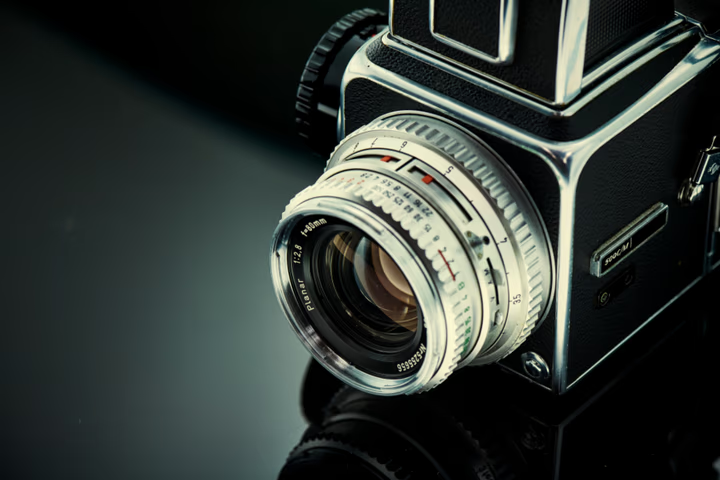
The list below is deliberately not a ranking, and deliberately not the usual all-male canon. It runs from the Victorian era to the late twentieth century, and covers documentary, portrait, fashion, street, landscape and conceptual work. Each entry suggests one specific thing worth looking for rather than offering a general appreciation. Photo: Retro 56 — CC0, via Openverse.
The Nineteenth and Early Twentieth Century
1. Julia Margaret Cameron. Working in the 1860s and 1870s on the Isle of Wight, Cameron produced soft-focus portraits of Victorian sitters that were technically unfashionable in her own time and are now the reason she is remembered. Study how she used closeness and shallow focus to make a portrait emotional rather than descriptive. Her deliberate imperfections are a useful counterweight to the modern obsession with technical cleanliness.
2. Alfred Stieglitz. Photographer, gallerist and publisher, Stieglitz spent forty years arguing that photography belonged alongside painting. His own work moved from pictorialism to a hard-edged modernist style. Look at his city views and his portraits of Georgia O'Keeffe for a sense of how the same photographer can hold two completely different intentions.
3. August Sander. Sander spent decades photographing German people in categories: farmers, tradesmen, soldiers, the unemployed, the professional classes. His project makes an argument about how a society looks. Look for the neutrality of his framing, and notice how much character survives inside an apparently plain portrait.
4. Edward Weston. Weston photographed peppers, shells, dunes and nudes with the same attention, treating an object and a body as equivalent problems of form. Look at how he used light to describe a surface, and study the way he cropped to make a familiar object strange. He is a useful reminder that subject matter matters less than what you do with it.
5. Imogen Cunningham. A contemporary of Weston and a founding member of the f/64 group, Cunningham photographed plants, nudes and portraits across a career of seventy years, and kept working into old age. Study her botanical images for precision, and then her portraits to see how much personality she could extract from a plain setup.
6. Berenice Abbott. Abbott photographed New York's architecture and street life in the 1930s, then spent years making scientific photographs of physics phenomena. Look at how carefully she composed documentary work: it is evidence and composition at the same time, which is much harder than it looks.
7. Man Ray. A painter and photographer in the Dada and Surrealist circles, Man Ray made photograms he called rayographs, plus fashion and portrait work. Worth studying for how far photography can be pushed away from describing things.
Documentary and Photojournalism
8. Dorothea Lange. Lange's Depression-era work for the American government produced images that shaped public opinion and policy. Study her captions alongside her photographs. She took the act of writing down what a subject said as part of the job, and photography would be better if more people still did.
9. Walker Evans. Evans photographed American buildings, signs and people in a flat, frontal, unsentimental way. His work with James Agee on the lives of tenant farmers is one of the foundations of documentary photography. Look at how much he trusted the frame to carry meaning without help.
10. Henri Cartier-Bresson. Co-founder of Magnum and the most quoted street photographer in history. His idea of the decisive moment has been argued about for eighty years. Study his contact sheets rather than his greatest hits; the ratio of decent frames to published ones is the most useful thing in them.
11. Robert Capa. Capa covered five wars, co-founded Magnum, and produced a famous observation that if your pictures are not good enough you are not close enough. His work raises questions about risk, ethics and the cost of the images that audiences demand, which remain open.
12. Brassaï. A Hungarian working in Paris, Brassaï photographed the city at night when film and flash made that genuinely difficult. Look at how he used fog, street lighting and mist to make ordinary streets feel like sets.
13. André Kertész. Kertész shaped street photography, composition and the use of distortion decades before those ideas became standard. Study his window light and his shadows: he built pictures out of geometry rather than events.
14. Bill Brandt. Brandt photographed British class divisions, then shifted to unsettling nudes and landscapes. His habit of changing direction completely is worth understanding. He treated style as a tool for a project rather than a signature.
15. W. Eugene Smith. Smith worked in photo essays, and believed the sequence carried the argument. His coverage of Minamata disease is a landmark of advocacy photography. Look at how he structured a story across spreads rather than as single images.
16. Gordon Parks. Parks worked for the American government's photography project and then as a photographer and editor for Life, covering civil rights, poverty and segregation. His images managed to be both formal and angry, which is a difficult combination to hold.
17. Robert Frank. Frank's book about American life, published in the 1950s, was dismissed then and is now treated as one of the most influential photo books ever made. Look at how loose and off-balance his framing is, and how deliberately he used it to convey dislocation.
18. Mary Ellen Mark. Mark spent decades photographing people on the edges of American society, with a long-term commitment to individual subjects. Look at how much time clearly went into being allowed to make those pictures.
19. Josef Koudelka. Koudelka photographed Roma communities in Czechoslovakia and secretly documented the 1968 Soviet invasion of Prague. Study his wide framing and the way he places a subject inside a difficult, crowded composition rather than isolating it.
20. Sebastião Salgado. Salgado photographed manual labour, migration, famine and later the planet's remaining wilderness at an enormous scale. His style is polarising, which makes him useful: decide for yourself whether the epic treatment of human suffering clarifies or aestheticises it.
21. Susan Meiselas. Meiselas photographed the insurrection in Nicaragua and has since worked repeatedly on how photographs of conflict circulate and are used. Study how she treats the people she photographs as participants rather than subjects.
22. Martin Parr. Parr photographs British and global leisure with bright colour and deliberate use of the flash, and he has been accused of mocking his subjects since he started. Look at how a photograph can be funny and critical at the same time, then decide where you stand.
Street, Colour and the Everyday
23. Diane Arbus. Arbus photographed people on the margins of convention, repeatedly and with the cooperation of her subjects. Her framing is deceptively frontal. Study how much of the discomfort in her pictures comes from the subject's gaze rather than the subject's appearance.
24. Garry Winogrand. Winogrand photographed American streets obsessively and left a vast number of unedited frames behind. Look at his wide lenses and tilted horizons, and notice how much he trusted a busy frame to be legible without simplification.
25. Lee Friedlander. Friedlander photographs the American social landscape, using reflections, shadows, poles and car windows to fragment the frame. His self-portraits are worth as much attention as his street work. Study how he uses reflections to layer two scenes at once.
26. William Eggleston. Eggleston's colour work made ordinary American subjects legitimate photographic material. Look at how he photographed parking lots and ceilings with the same seriousness as an expensive commission. His influence on colour photography is hard to overstate.
27. Saul Leiter. Leiter photographed in colour on the New York streets in the 1950s, working through windows, reflections and partial occlusion. Study how much he was willing to hide from the viewer.
28. Helen Levitt. Levitt photographed children and street life in New York with a light touch, and later worked in colour. Look at her framing: she caught gestures that read as play and choreography.
29. Roy DeCarava. DeCarava photographed Black life in Harlem with a dark, beautiful tonal range and a strong sense of dignity, working as both photographer and painter. Study how he handled low light and skin tones at a time when the materials fought against him.
30. Daido Moriyama. Moriyama photographed Japanese cities in high-contrast, grainy, deliberately blurred images that made the style itself the subject. Study how much information he was willing to discard, and what that does to a viewer's attention.
Fashion and Portrait
31. Richard Avedon. Avedon photographed fashion and portraits against plain white backgrounds, stripping everything away until only gesture and expression remained. Compare one of his portraits with a heavily produced contemporary celebrity shoot. The gap tells you what has been lost.
How to Study a Photographer Properly
Pick one person and give them a fortnight rather than an evening. Look at a full body of work, including the parts you dislike, and read what they said about the work in their own voice. Interviews and introductions usually explain the intention far better than a caption can.
Then look at the equipment and the era. Half the apparent magic in mid-century work was a constraint: a limited ISO, a fixed lens, a slow shutter, a roll with twelve frames. Constraints produce decisions, and decisions produce style. That insight is more useful than any attempt to reproduce the look.
If you are working on your own technique, take a specific lesson from each photographer into a shoot rather than a general impression. The composition approaches that hold up under pressure are largely the ones developed by these people, and the lighter, more mobile posing techniques used in editorial work are direct descendants of them.
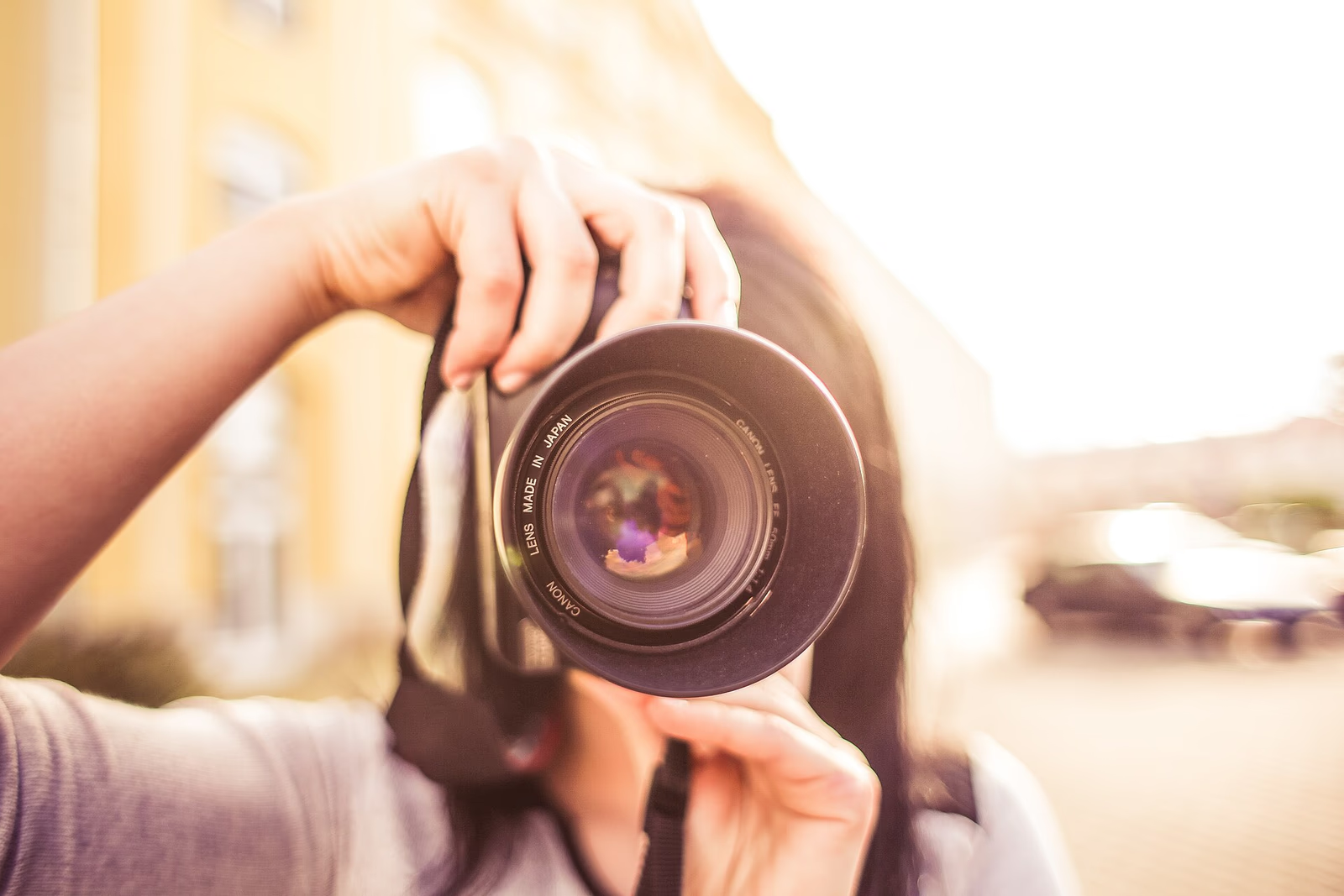
Photo: CCØ BAY — CC0, via Wikimedia Commons.
Watch What They Chose Not to Shoot
The most revealing thing about a serious photographer's work is its limits. Cartier-Bresson barely photographed landscape. Avedon almost never photographed a scene with depth. Weston did not do events. Those refusals are what gave each body of work its coherence.
Audit your own archive for the same thing. Look at what you photograph consistently, then look at what you keep shooting out of habit with no results to show for it. Most people discover two or three areas where all their best work lives, and a much larger pile where they have been going through the motions.
Then study the light in their work. Most of the photographers on this list worked in conditions they could find rather than conditions they could create, and learning to see how the light changes across the day is what turns their example into something you can use. Their negatives are the primary record of that practice, which is part of why preserving photographic archives as physical material still matters, as anyone who has tried to digitise old photographs properly will tell you.
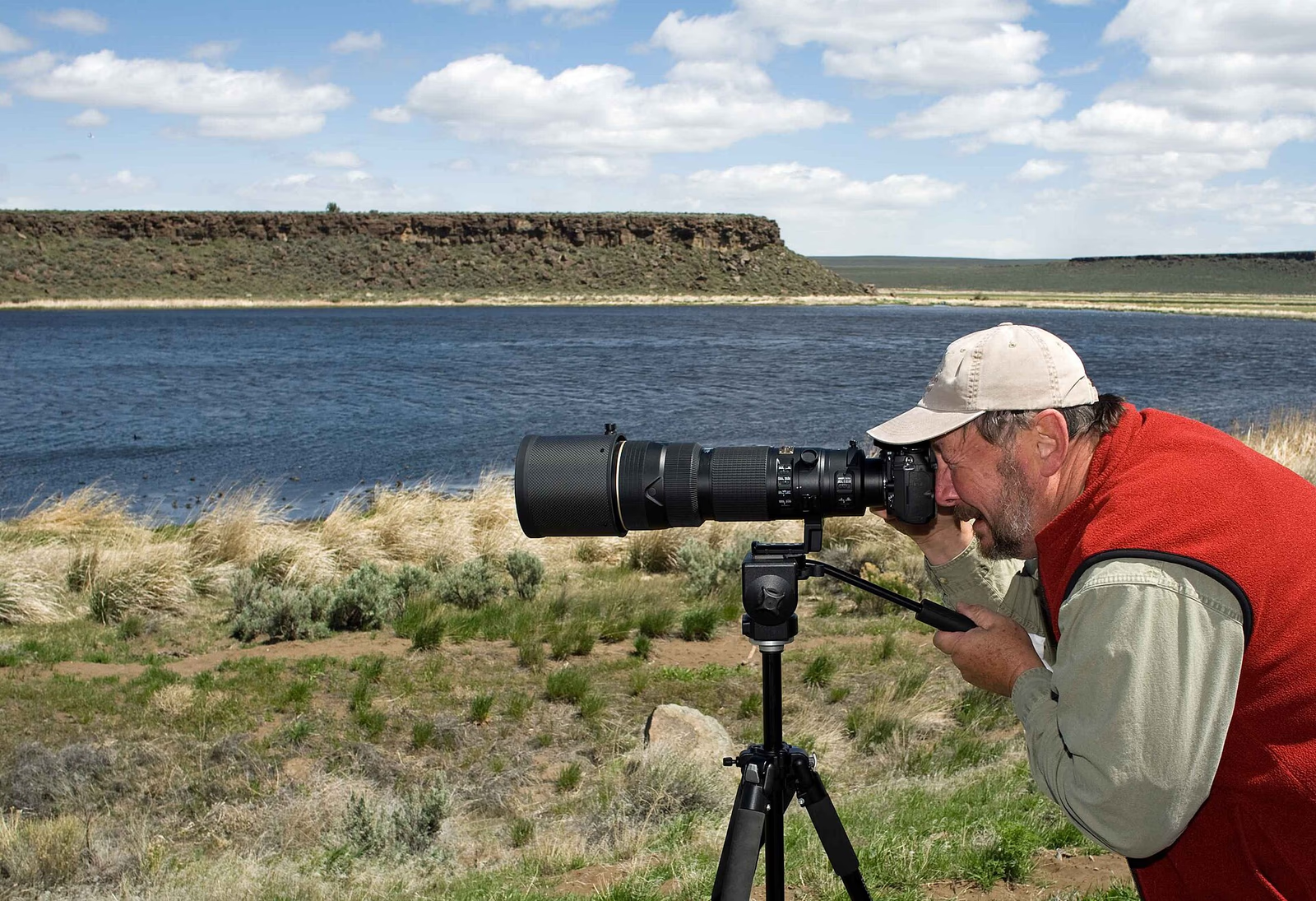
Photo: Gentry George, U.S. Fish and Wildlife Service — Public Domain, via Wikimedia Commons.
Conclusion
Thirty-one names is a start, not a canon. Treat the list as a set of doors rather than a syllabus to complete, and follow whichever one interests you for a fortnight.
The photographers worth lasting attention are almost never the ones with the most dramatic subject matter. They are the ones with a consistent point of view that survived contact with years of work. That is a harder thing to build than a portfolio of impressive single images, and it is the only thing that makes a body of work worth returning to.
FAQ
Which photographer should a beginner study first?
Whichever one shoots what you shoot. Start with the genre you already work in, because the lessons transfer immediately, and only branch out once you can describe what you like about the first one's work in specific terms.
Why is this list mostly photographers from before 1980?
Because the influence of earlier work is easier to trace and its lessons are more settled. Living photographers are still arguing with themselves, which is interesting but a harder place to learn the fundamentals.
Do I need to look at prints rather than screens?
Prints are better, and for mid-century work they are considerably better, since reproduction quality varies enormously and much online material is low resolution. If a print is not available, a well-made book is the next best option.
How much time should I spend studying other photographers?
An hour a week beats a binge. Look at work in parallel with your own shooting so that lessons can be tested, and keep a note of specific things you want to try rather than general admiration.
What should I look for when studying a photograph?
Start with where the subject sits in the frame, then the direction and quality of the light, then the moment captured. Once those three are legible, ask what the photographer chose to leave out.
Does studying famous photographers just teach imitation?
Only if you copy the surface. Copy the thinking instead: what problem were they solving, what constraint were they under, and what did they refuse to do? Copying the thinking tends to produce your own work rather than a worse version of theirs.
Continue reading
How Big Is a 4×6 Photo? Sizes in Inches, Centimeters, and Pixels
May 24, 2026
A French Woman Walks Into Nordstrom — 33 Items She's Buying From the Half-Yearly Sale
May 24, 2026
The 4 Best Ways to Digitize Old Photos (and How to Store Them)
May 24, 2026
How to Take the Perfect Engagement Photos: The 5 Rules
September 27, 2026
42 Free Photography Books to Download (PDF + eBooks)
May 24, 2026
Afterparty Style: Why Custom Clothing Is the Ultimate Expression of Personal Identity
May 25, 2026
Why People Are Starting to Hate AI — And What Fashion Brands Need to Understand
May 24, 2026
12 Grandparent-and-Grandchild Photo Poses
May 24, 2026
27 Flattering Portrait Poses
September 25, 2026
Family Photoshoot Poses
September 25, 2026
Met Gala Photographer Hunter Abrams' Tips for Peak Creativity
September 27, 2026
Ryan McGinley's Top Tips for Taking Stylish Travel Photos
September 27, 2026
Strike a Pose: Street Style Star Hanneli Mustaparta Shows Us How
September 27, 2026
Fashion's Top Executives Gather in London to Explore AI's Role in the Industry
May 24, 2026
Colorful Shoes, Woven Bags, Tankinis: 7 Fun Summer Trends Worth Shopping Right Now
May 25, 2026