Annie Leibovitz on 5 Images That Have Shaped Her Career
Annie Leibovitz has photographed presidents, rock stars, actors and royalty for more than four decades, and her portraits have done as much as anyone's to de...
Annie Leibovitz has photographed presidents, rock stars, actors and royalty for more than four decades, and her portraits have done as much as anyone's to define what a famous person is supposed to look like. She started at Rolling Stone in 1970 as a photojournalist documenting the counterculture, became the magazine's chief photographer in 1973, and later moved to Vanity Fair and Vogue, where she built the elaborate, staged portraiture she is known for now.
Her book Annie Leibovitz: Portraits 2005–2016 collects a decade of that work, and the interviews around it are unusually useful, because she talks about pictures rather than about herself. Five images in particular trace the shape of her career: they show a photographer learning how to work with people, and then never stopping. Photo: Scientist (chemist) Siarhei Besarab Studio portrait 2026 (01).jpg_Siarhei_Besarab_Studio_portrait_2026_(01).jpg) by Volha Sh — CC BY-SA 4.0, via Wikimedia Commons.
1. John Lennon and Yoko Ono, New York, December 1980
The photograph that made her famous was taken hours before John Lennon was shot. Leibovitz had been sent by Rolling Stone to photograph him, and the session turned into a portrait of the two of them together. Accounts of the shoot agree on the essentials: Lennon wanted to be photographed naked with Ono, Ono declined to appear nude, and the solution was Lennon curled around her, clothed, holding on.
The image ran on the cover of Rolling Stone without a headline, and it is still one of the most recognisable magazine covers ever printed. What it demonstrates is the thing Leibovitz spent the next four decades refining: the willingness to let the subject's own instinct shape the picture, and the patience to keep working while that instinct surfaces.
2. Whoopi Goldberg in a Bathtub of Milk, 1984
A year out from The Color Purple, Goldberg was photographed in a bathtub of milk for Vanity Fair, her head and shoulders emerging from a white surface that makes the frame read almost as a graphic object before it reads as a person.
It is a useful image to study because it shows what a simple concept can do when it is executed without compromise. One idea, one prop, one unusual environment. Nothing about the picture is subtle, and nothing about it is accidental either. The milk is a visual pun, but the photograph works because the subject committed to it completely, which is only possible when a photographer has spent enough time beforehand to make the absurd feel reasonable.
3. Demi Moore, Vanity Fair, August 1991
The August 1991 cover of Vanity Fair, with Moore naked and pregnant, holding her belly, caused a public argument that ran for years. Some newsstands wrapped it. Others refused to stock it. It remains the most discussed magazine cover of that decade and one of the images that changed what a mainstream American magazine could print.
For a photographer, the interesting part is not the controversy but the planning: the lighting is careful, the pose is sculptural, and the subject is composed rather than exposed. A portrait designed to be provocative is still a portrait, and it still depends on the person in front of the lens trusting the person behind it.
4. Queen Elizabeth II, Buckingham Palace, 2007
Photographing a head of state who has been photographed tens of thousands of times is a different problem entirely, and Leibovitz's 2007 sitting at Buckingham Palace is a case study in directing someone who is not used to being directed.
The shoot produced formal state portraits, including one in heavy velvet robes that reads as a deliberate contrast with the more casual images released that year. What is notable about the session, in the accounts that followed it, is how much of the work happened in conversation rather than through instructions, and how the setting itself was treated as part of the portrait rather than as a background. When your subject outranks everyone in the room, the only available leverage is the idea you arrived with.
5. Caitlyn Jenner, Vanity Fair, June 2015
The June 2015 cover, with the accompanying line "Call Me Caitlyn," was Jenner's first portrait after her transition and one of the most widely viewed magazine images of the decade. The shoot was styled, lit and composed with the same production values as any Leibovitz celebrity portrait, which was the point: the subject was treated as a subject, not as a news event.
That instinct, to photograph people as they wish to be seen while still imposing a strong visual idea, is what connects an image from 2015 back to a photo shoot in a New York apartment in 1980.
Photo: Camera operator at fountain in Korolyov.jpg by Dmitry Ivanov. — CC BY-SA 4.0, via Wikimedia Commons.
What the Five Images Have in Common
Across 35 years, the production values change and the subjects could hardly be more different, but the working method behind each picture is remarkably consistent.
She arrives prepared. Leibovitz is known for detailed pre-production and elaborate sets. The concept exists before the subject walks in, which is what allows the session to stay calm while everyone else is nervous.
She leaves room for the unplanned. Preparation is not the same as control. The strongest frames in her career are often the ones that no amount of planning could have predicted, and the skill lies in recognising the moment when it arrives instead of stopping it.
She invests time before the camera comes out. Decades of interviews produce the same answer about how she gets guarded people to relax: she talks to them, learns about them, and finds common ground. The camera is almost incidental.
She treats the session as a collaboration. Not a transaction where a subject is arranged and recorded, but a piece of work made by two people, one of whom happens to be holding a camera.
If there is a single theme worth stealing from her career, it is that the photograph is the last five per cent of the process. The rest is concept, preparation and relationship, and none of it is visible in the final frame. The photographers who last, as the careers of the people on this list suggest, are usually the ones who understood that early.
Why She Still Prints Her Work
In an era when almost every photograph is viewed on a screen, Leibovitz remains an advocate for the physical print. She has argued repeatedly that seeing an image as an object, held in your hands or hung on a wall, is a fundamentally different experience from scrolling past it.
She is right, and the reason is not nostalgia. Scale changes what a photograph communicates. Texture and paper stock change how it reads. A print cannot be glanced at and swiped away, so it forces a slower kind of attention, both from the viewer and from the photographer who has to decide whether the image can survive that attention.
Photographers who have only ever seen their own work on a phone are working without that test. Printing a handful of images a year is a cheap way to find out whether a picture is actually good.
Learning From Every Frame
The other thread running through her career is a refusal to settle. Leibovitz began with raw, intimate journalism, moved into highly produced conceptual portraiture, and has since pushed into landscape work and personal documentary projects.
That progression is the part most photographers can copy directly. It does not require her budgets or her access. It only requires agreeing that whatever you are good at now is not the final version of your work. If you are going to spend the year studying, a shelf of books worth reading is a better investment than another lens, and the lines that photographers keep repeating to each other tend to make more sense once you have actually shot the pictures they are about.
Photo: "Everything is Going to be Alright" artwork, Christchurch Art Gallery, Christchurch, New Z by Michal Klajban — CC BY-SA 4.0, via Wikimedia Commons.
Practical Takeaways
- Prepare thoroughly. Know the location, the lighting plan and the concept before the subject arrives.
- Spend the first minutes talking rather than shooting. Trust is what makes the later frames possible.
- Stay open to accidents. The best image is often adjacent to the one you planned.
- Print your work. Seeing it as an object changes how you judge it.
- Study the photographers you admire, then stop imitating them and build your own visual language.
- Keep moving into unfamiliar territory. The photographers who last are the ones who never decide they are finished learning.
Conclusion
Annie Leibovitz's reputation rests on images that most photographers will never have the access to attempt, but the method behind them is not exclusive. Arrive prepared, invest time in the person in front of you, leave room for what you did not plan, and treat the shoot as collaboration rather than transaction.
The technical side of photography can be learned by anyone with patience. What separates her work from the crowd is the ability to see people clearly, earn their trust, and translate that into a picture that feels both monumental and intimate. That is not a camera skill. It is a way of paying attention.
FAQ
What camera does Annie Leibovitz use?
She has worked across almost every format available, from the 35mm cameras of her early Rolling Stone years to medium and large format systems, and she has used digital extensively for years. Her equipment has always followed the idea rather than the other way around, which is why no single camera defines her work.
How does Annie Leibovitz get celebrities to pose so naturally?
She spends time with them. She talks, listens, learns about them, and treats the session as a collaboration rather than a transaction. On her 2007 Buckingham Palace sitting, much of the work happened in conversation. The trust that builds up is what allows subjects to drop their guard in ways they rarely do for other photographers.
What lighting does Annie Leibovitz use?
It varies enormously by concept. She is known for elaborate studio lighting on celebrity portraits and equally comfortable working with natural light. There is no signature lighting setup to copy, because the lighting is chosen to serve the idea of each individual image.
Why does Annie Leibovitz insist on printing photographs?
She believes photographs are meant to exist as physical objects. The experience of holding a print, or seeing an image at scale on a wall, is different from viewing it on a screen. Printing also imposes a useful discipline: an image has to survive slow, careful attention before you decide it is good.
How did Annie Leibovitz start her career?
She began as a photojournalist for Rolling Stone in the early 1970s, photographing the era's counterculture in an intimate, fly-on-the-wall style, and became the magazine's chief photographer in 1973. She later worked for Vanity Fair and Vogue, where her approach evolved into the produced celebrity portraiture she is known for today.
What is the most famous Annie Leibovitz photograph?
The December 1980 Rolling Stone cover of John Lennon and Yoko Ono, taken hours before Lennon was killed, is the image most often named. The 1991 Vanity Fair cover of Demi Moore and the 1984 portrait of Whoopi Goldberg in a bathtub of milk are close behind in recognition.
What can a beginner learn from Annie Leibovitz?
Three things transfer to any budget: prepare before the shoot, spend time with your subject before you raise the camera, and print a few of your best images each year. None of those require her resources, and all three change the work.
Continue reading
Met Gala Photographer Hunter Abrams' Tips for Peak Creativity
September 27, 2026
Want to Know What Your Customers Think? Ask an AI-Generated Focus Group
May 24, 2026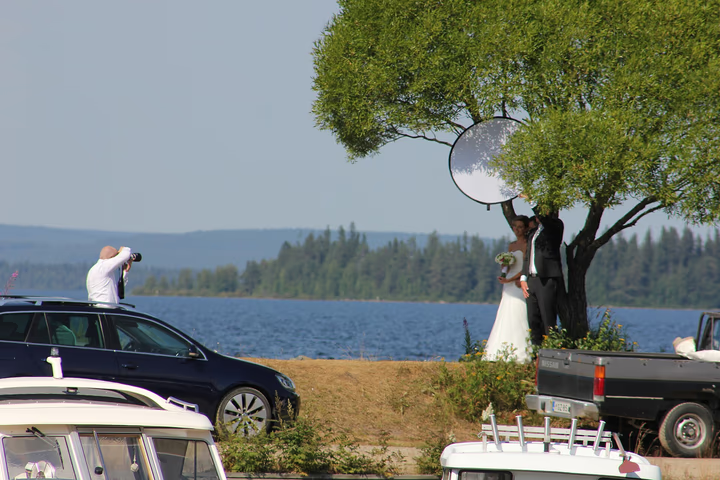
Everything to Know About Wedding Photography Styles
September 27, 2026
42 Free Photography Books to Download (PDF + eBooks)
May 24, 2026
123 Types of Photography to Try
September 25, 2026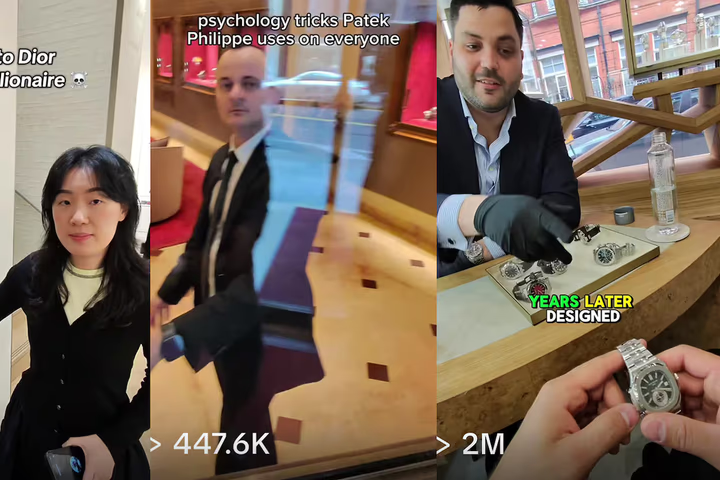
'POV Shopping' Videos Are Going Viral — And Luxury Brands Should Be Worried
May 24, 2026
99 Most Inspirational Photography Quotes
September 25, 2026
14 Best Stock Photography Sites
September 25, 2026
Afterparty Style: Why Custom Clothing Is the Ultimate Expression of Personal Identity
May 25, 2026
5 Chic Jeans and Top Combos You'll Be Wearing All Summer Long
May 24, 2026
Making Money with Stock Photography
September 25, 2026
How to Shoot During Golden Hour: Lighting Guide
May 24, 2026
Why People Are Starting to Hate AI — And What Fashion Brands Need to Understand
May 24, 2026
8 Sustainable Fashion Photoshoot Ideas That Wow on Instagram
July 11, 2026
Colorful Shoes, Woven Bags, Tankinis: 7 Fun Summer Trends Worth Shopping Right Now
May 25, 2026