Making Money with Stock Photography
Stock photography has a reputation problem, and it is mostly deserved. The promise is passive income from photographs you would have taken anyway. The realit...

Stock photography has a reputation problem, and it is mostly deserved. The promise is passive income from photographs you would have taken anyway. The reality is a saturated market where the income distribution is extremely uneven and the per-download rate has fallen for twenty years.
None of that means it cannot pay. It means the money comes from a different place than most people expect. It is a volume business with a research component, not a lottery you enter by uploading your holiday pictures.
Here is what the market actually looks like, what still sells, what changed with subscription licensing, and why generative AI has made the whole calculation harder.
How the Money Model Changed
Traditional stock licensing charged a client a meaningful fee for each specific use: a print run, a campaign, a period of exclusivity. A single licence could pay a photographer well, and the same image could be licensed repeatedly at that rate.
Subscription and credit-based microstock replaced most of that at the volume end of the market. Contributors now typically earn a small fraction of a subscription's value per download, and a download may be pence or cents rather than pounds or dollars. The upside is that a single image can be downloaded thousands of times. The downside is that a popular image at a low rate can end up earning less than one old-fashioned rights-managed sale.
What this means practically: any individual download is close to meaningless, and only aggregate volume over years produces a meaningful total. Anyone thinking about this as a source of monthly income should be modelling hundreds or thousands of downloads, not twelve.
It also means contract terms matter more than they used to. Rates, commission percentages and licence structures differ substantially between agencies, and they get revised. Read the current contributor terms for whichever platforms you are considering rather than trusting last year's blog post, including this one. Photo: Andrew Pons — CC0, via Openverse.
The Distribution Problem Nobody Mentions
Contributor earnings follow a power law. A small number of photographers with large, well-researched, well-keyworded portfolios take a disproportionate share of library downloads, and the majority of contributors earn very little in absolute terms.
This is not a reason to avoid stock photography. It is a reason to be honest about which category you are likely to land in during your first year, which is the low one. The portfolios that do work share three features: they are large, they are internally consistent, and they were shot to fill gaps that other contributors had not filled.
If your plan involves uploading 200 photographs and waiting, the plan is not finished. Expect to treat it as a long project with a research phase, or do not start.
What Still Sells
Broad lifestyle photography, generic sunsets and unremarkable cityscapes are the most oversupplied categories in any library. They also happen to be the easiest to shoot, which is precisely why the supply is infinite.
Demand holds up better in several narrower areas:
- Specific industries and occupations. Real welders and real lab technicians in properly equipped settings, not models in borrowed hard hats.
- Culturally and ethnically specific subjects. Libraries remain thin on authentic representation across many communities, and buyers actively look for it.
- Hard-to-shoot technical subjects. Medical, scientific, industrial and agricultural work requires access that most contributors do not have.
- Specific locations and architecture, including less-photographed regions, where buyers want accuracy rather than generic prettiness.
- Seasonal and calendar material, submitted well ahead of the season rather than during it.
- Concepts that are awkward to stage, such as ageing, care work, grief, chronic illness and disability, where libraries are genuinely weak.
The pattern is consistent: value lives where production is difficult, not where it is pleasant.
Shoot Deliberately, Not Opportunistically
The contributors who do well mostly stop treating stock as a byproduct. They pick a subject, research what already exists in the libraries, identify what is missing, and then plan a shoot around the gap.
That research step is the part people skip. Spend an afternoon searching each agency for your intended subject and note what comes back. If there are fifty thousand near-identical results, you need a plan to be different. If there are four hundred results and none of them are any good, that is an opening.
Treat it as a brief. If you are shooting a series on small-business owners, decide the industries, the settings, the wardrobe, the diversity of the people involved, and the shot list that a designer would need: wide establishing frames, mid shots, close details like hands on equipment, and clean negative space for text overlays.
Releases and Paperwork
Two documents determine what your images can be licensed for, and getting them wrong removes most of the commercial value.
A model release comes from every identifiable person in the frame. Without one, the image is generally restricted to editorial licensing, which pays less and sells less. A property release covers identifiable private property, distinctive buildings, artwork and some logos.
Shoot with paperwork in mind. If you are photographing a workshop, get a release from the owner and from anyone whose face is visible. Releases can be collected afterwards, but chasing signatures six months later is a miserable and frequently unsuccessful task.
Keep the release file attached to the image's record. A library that cannot verify consent will not use the image commercially, and neither will a buyer.

Photo: Negative Space — CC0, via Openverse.
Keywording and Metadata
Stock is a search problem before it is a photography problem. An excellent photograph with careless metadata earns nothing, because nobody finds it.
Write titles that describe the actual content in plain language, including the specific rather than the generic: not "business people meeting" but "two women reviewing building plans on a construction site." Fill the description with what a buyer would type, including variants and near-synonyms, and include the concept as well as the object. Add location data where it is accurate.
Do not keyword-spam. Irrelevant terms get files downranked and can get contributors removed, and they poison the search results for everyone else.
Agency Tiers
Libraries sit in roughly four groups, and they serve different purposes.
Microstock accepts almost anyone, pays per download at low rates, and rewards volume. Mid-tier agencies are more selective and pay better per licence. Macrostock and specialist agencies deal in higher-value rights-managed licensing and expect a defined style. Editorial and news services license un-released documentary and newsworthy material that cannot be sold commercially.
Most contributors are better served by concentrating on one or two libraries rather than spreading thin across eight.
The AI Problem
Generative models have flooded every library that accepts them, and buyers can now commission synthetic imagery directly. The effect on contributors has been both a drop in demand for generic material and an enormous increase in the supply of it.
The consolation, and it is a real one, is that the areas where AI is weakest overlap heavily with where stock value already was. Verified real people in real settings, subjects requiring access, accurate specific locations and anything that needs a release all resist synthetic substitution. Buyers in editorial and reporting contexts also increasingly need provenance they can defend, which favours photographs with a clear chain of origin.
If you want to read more about how these tools are being adopted commercially, the debate around AI-generated mockups in fashion campaigns shows the industry arguing with itself in public. At industrial scale, AI-assisted production of millions of images a year gives you a sense of where the volume end of the market is heading.
Photo: Hamster28 — Public Domain, via Wikimedia Commons.
Tax and Records
Stock income is income. Track every payment, keep the agency statements, and record your expenses: travel, props, models, releases, software and a proportion of your equipment. If you are working across borders, withholding tax on foreign agency payments is a common surprise, and many countries have treaty arrangements that reduce it if you file the right form.
Set aside a proportion of income as you earn it rather than spending it and facing a bill later.
Tips from People Who Make It Work
- Research the library before you shoot, and target a gap you can name.
- Build one coherent portfolio rather than a scattered set of unrelated images.
- Get releases signed on the shoot, every time, and store them against the file.
- Write metadata as carefully as you shoot. It is half the job and almost nobody does it well.
- Accept that year one is a research and volume-building period, not an income period.
- Exploit what generative tools cannot produce: real access, real people, verified locations, documented events.
- Track costs against income honestly. Gear is easy to buy and hard to earn back.
Conclusion
Stock photography still pays, but it pays like farming rather than like investing. You plant more than you harvest, the harvest is uneven, and the contributors who do best are the ones studying what the market lacks rather than what they enjoy shooting.
If that sounds unappealing, the market is telling you something useful. If it sounds like a reasonable long-term project, the first step is not a shoot. It is an afternoon of searching libraries for what is missing, and writing down the brief that comes out of it. Technical understanding helps here too, since knowing what modern sensors can and cannot capture is part of choosing achievable subjects; the broad direction of AI and computational tools inside cameras is worth understanding before you plan equipment around it.
FAQ
How much can a beginner realistically earn from stock photography?
Very little in the first year, and the honest answer is that most contributors never reach meaningful income. Individual downloads pay small amounts, so earnings depend on accumulation across a large, well-targeted portfolio over several years. Treat early income as validation of your approach rather than as a wage.
Should I upload to many agencies at once?
Usually not at the start. Two libraries is enough to learn the metadata requirements, the review standards and the reporting interface properly. Adding more agencies multiplies the admin work before it multiplies your income.
Do I need model releases for stock photos?
For commercial licensing, yes, from every identifiable person. Without one, the image is typically limited to editorial use, which pays less and sells less often. Property releases are also needed for identifiable private buildings and property.
What sells best on stock sites these days?
Specific, hard-to-produce material: particular industries and occupations, under-represented communities, technical and medical subjects, accurate specific locations, and concepts that are difficult to stage. Generic lifestyle photography is the most oversupplied and least rewarding category.
Is stock photography still worth doing now that AI generates images?
The generic middle of the market has been badly hurt. Verified real subjects, real access, documented events and anything requiring a release have held up better, because buyers in commercial and editorial contexts need provenance. If your plan was generic imagery, the plan needs replacing.
How long before a stock portfolio generates consistent income?
Realistically several years, and only with deliberate shooting and disciplined metadata rather than bulk uploads of existing work. Portfolios that succeed tend to be large, focused and built around research into demand.
Continue reading
'POV Shopping' Videos Are Going Viral — And Luxury Brands Should Be Worried
May 24, 2026
Every Chic Londoner Is Wearing One of These 5 Summer Heatwave Staples This Weekend
May 25, 2026
How to Take the Perfect Engagement Photos: The 5 Rules
September 27, 2026
Colorful Shoes, Woven Bags, Tankinis: 7 Fun Summer Trends Worth Shopping Right Now
May 25, 2026
How Big Is a 4×6 Photo? Sizes in Inches, Centimeters, and Pixels
May 24, 2026
Strike a Pose: Street Style Star Hanneli Mustaparta Shows Us How
September 27, 2026
Photographer Gray Malin's Travel Tips and the Art of the Aerial Beach Photograph
September 27, 2026
How to Shoot During Golden Hour: Lighting Guide
May 24, 2026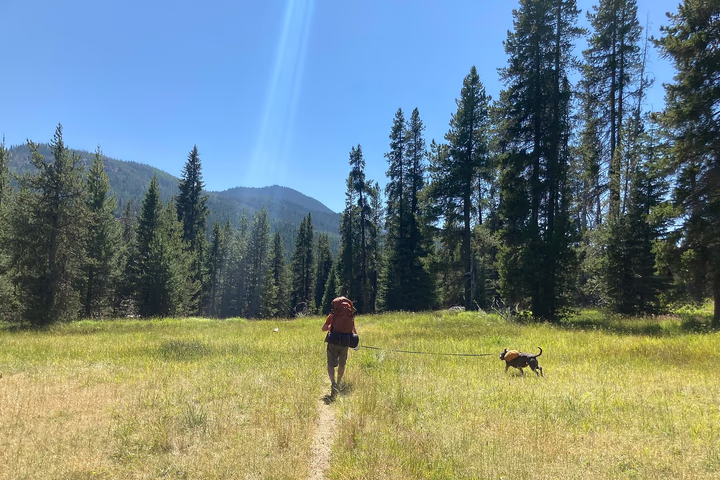
Ryan McGinley's Top Tips for Taking Stylish Travel Photos
September 27, 2026
Family Photoshoot Poses
September 25, 2026
Master Flow Posing Photography: 9 Dynamic Techniques
July 11, 2026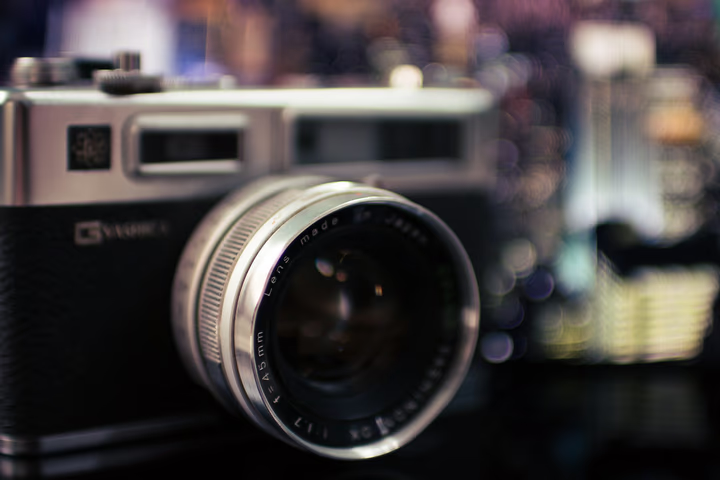
13 Unique Father's Day Gifts That Go Way Beyond the Usual Mug
May 24, 2026
12 Grandparent-and-Grandchild Photo Poses
May 24, 2026
How to Pose and Photograph Shy, Difficult, or Anxious Pets
September 25, 2026
9 Steps to Finding the Perfect Wedding Photographer
September 27, 2026