42 Free Photography Books
The oldest photography books are free, and that surprises people who assume the good ones sit behind a paywall. Copyright expires. Manuals published in the 1...
The oldest photography books are free, and that surprises people who assume the good ones sit behind a paywall. Copyright expires. Manuals published in the 1800s are now in the public domain, which means the compositional arguments, the studio practice and the printing knowledge of the first photographers circulate at no cost to anyone who looks.
That material is not just historical curiosity. Henry Peach Robinson was arguing about pictorial composition a century before anyone invented the word bokeh, and his reasoning still applies to how you frame a portrait today. The chemistry has changed. The problems have not.
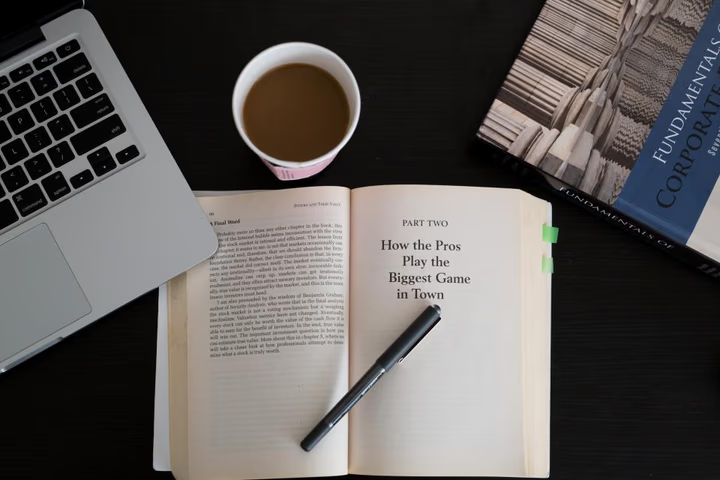
This list has 42 entries in three groups: public-domain books and manuals, free archives and collections that function like a library, and free teaching resources worth bookmarking. A few are complete downloadable books. Others are large open collections, which is often more useful. Availability of any individual title varies by country and platform, so treat the entry as a starting point rather than a guaranteed download link. Photo: Raymond Sam — CC0, via Openverse.
Public-Domain Books and Manuals
1. The Pencil of Nature by William Henry Fox Talbot (1844). The first commercially published book illustrated with actual photographic prints. Study it as an object as much as a text; the idea of a photograph as a published document starts here.
2. Naturalistic Photography for Students of the Art by Peter Henry Emerson (1889). Emerson argued that photography should stop imitating painting and be treated as its own art form with its own truths. The argument still shapes how photographers talk about authenticity.
3. Pictorial Effect in Photography by Henry Peach Robinson (1869). A systematic attempt to adapt the composition rules of painting to the camera. Useful even where you disagree, because the disagreements are instructive.
4. The Studio, and What to Do in It by Henry Peach Robinson. By the same author, and much more practical: posing, drapery, backdrops and the working habits of a Victorian portrait studio.
5. A Manual of Photography by Robert Hunt. First published in the 1840s and revised across several editions, this is a technical manual of early processes, and a reminder that photographers were chemists before they were anything else.
6. The Camera and the Pencil by Marcus Aurelius Root (1864). A portrait photographer's account of the trade in mid-nineteenth century America, including how he thought about lighting a face and why sitters were so often uncomfortable.
7. Art Principles in Portrait Photography by Otto Walter Beck (1907). Composition, tone and retouching written for portrait workers. The retouching chapter is a good corrective to anyone who thinks heavy digital skin work is a modern invention.
8. Composition by Arthur Wesley Dow (1899). Not exclusively about photography, and all the better for it. Dow's design principles were read by pictorialist photographers and still explain why some arrangements hold the eye.
9. Photography in the Studio and in the Field by Edward M. Estabrooke. A late nineteenth century practical manual covering darkroom work, studio lighting and location shooting, with the tone of someone who had made every mistake already.
10. The Barnet Book of Photography. A collected anthology of essays by different photographers, published as a yearly volume around the turn of the twentieth century. A good way to see how much opinion varied inside a single profession.
11. Camera Work edited by Alfred Stieglitz, 1903 to 1917. Stieglitz's quarterly journal, complete public-domain issues of which survive in open archives. It paired photogravures of the best photographs of the era with writing about modern art.
12. The American Annual of Photography. Yearly volumes from the late nineteenth century onwards, mixing technique, criticism and pictures. Read three consecutive years and you can watch photographic taste change in real time.
13. Sun Pictures in Scotland by William Henry Fox Talbot (1845). An early photographic travel book, and evidence that photography was used to sell places to armchair travellers almost from the moment it worked.
14. The Chemistry of Light and Photography by Hermann Vogel. Vogel's work on dye sensitisation in the 1870s is part of why colour photography became possible. Dry in places, significant throughout.
15. Nineteenth-century photographic periodicals. The Photographic News, The British Journal of Photography and The Photographic Times all have volumes in open archives. Trade press is where you find the arguments practitioners actually had.
Free Archives and Collections Worth Treating as a Library
16. Project Gutenberg. Tens of thousands of public-domain books, including photographic manuals and art criticism of the pre-1929 era. The search is crude, and the patience required is worth it.
17. Internet Archive. Digitised books, periodicals and catalogues with a strong photographic holdings. Many photographic titles appear here that exist nowhere else online.
18. Open Library. The lending side of the Internet Archive project. Some in-copyright twentieth-century photography books can be borrowed digitally, which is how you read the mid-century material that is still locked down.
19. Library of Congress Prints and Photographs Online Catalog. Enormous, free, high-resolution and well documented. Useful both for study and for research into how documentary photography was made and catalogued.
20. The Met Open Access. A large set of images released for unrestricted use, including photographs and photographic books. Strong on nineteenth-century work.
21. Getty Open Content. Public-domain images from the Getty's collections, free to use. Good for studying the transition from painting to photographic portraiture.
22. Rijksmuseum Rijksstudio. High-resolution images, free to download and remix. Cataloguing quality is unusually high, which matters when you are trying to learn from a picture.
23. Smithsonian Open Access. Millions of items released without restrictions, spanning scientific, documentary and commercial photography.
24. Europeana. Aggregated European museum, library and archive material with a photography section that is deep on early work and on photojournalism.
25. Wikimedia Commons. The reference collection for photographs whose copyright has expired, plus a healthy set of press and government images. Better metadata than most people expect.
26. Flickr Commons. Institutions posting historical photography with no known copyright restrictions. The comments on those images are often more informative than the catalogue records.
27. New York Public Library Digital Collections. Strong on documentary, street and theatrical photography, with a large public-domain subset.
28. NASA image libraries. Free, high-resolution and technically fascinating. Also the clearest example of how a technical brief shapes an entire visual language.

Photo: Freestocks.org — CC0, via Openverse.
Free Teaching Resources
29. Strobist's Lighting 101. A free course on small-flash lighting that has taught a generation of photographers to work with one speedlight and a cheap umbrella. Still the best value on the internet because the price is nothing.
30. Cambridge in Colour. Long-form, careful explanations of exposure, sensor behaviour, diffraction and depth of field. Unfashionable design, unusually reliable content.
31. Open Source Photography. Tutorials built around open-source editing tools, which matters if you object to subscription software.
32. Photography Life. A deep archive of technical explainers and gear discussions. Search rather than browse; the library is large and uneven.
33. PetaPixel. News and technique with a high publishing rate. Useful for staying current with how the industry is arguing with itself.
34. Digital Photography Review article archive. Reviews and technical analysis going back decades, including camera tests that are still the clearest writing available on sensor performance.
35. The Online Photographer. Essays and commentary rather than tutorials, and a rare place where the craft is discussed as a practice rather than a product category.
36. Luminous Landscape. Field reports and technique, particularly strong on landscape workflow and printing.
37. B&H Explora. Free educational articles from a retailer, written to a higher standard than that arrangement usually produces.
38. Magnum Photos essays and photographer pages. Bodies of work with context, free to read, and one of the fastest ways to understand what a coherent photographic project looks like.
39. LensCulture free articles and interviews. Contemporary photography writing, useful for seeing the current shape of the medium.
40. Adobe's free Lightroom and Photoshop tutorials. Vendor material, but well structured and kept current with the software's actual interface.
41. Manufacturer learning centres. Camera makers publish substantial free guides on exposure, autofocus modes and flash, written for their own hardware and transferable to everything else.
42. Public-domain scanning and documentation guides. The digitisation workflows published by national libraries and Wikimedia explain how to photograph flat documents and fragile books properly, which is a skill worth having before you start scanning your own prints and negatives.
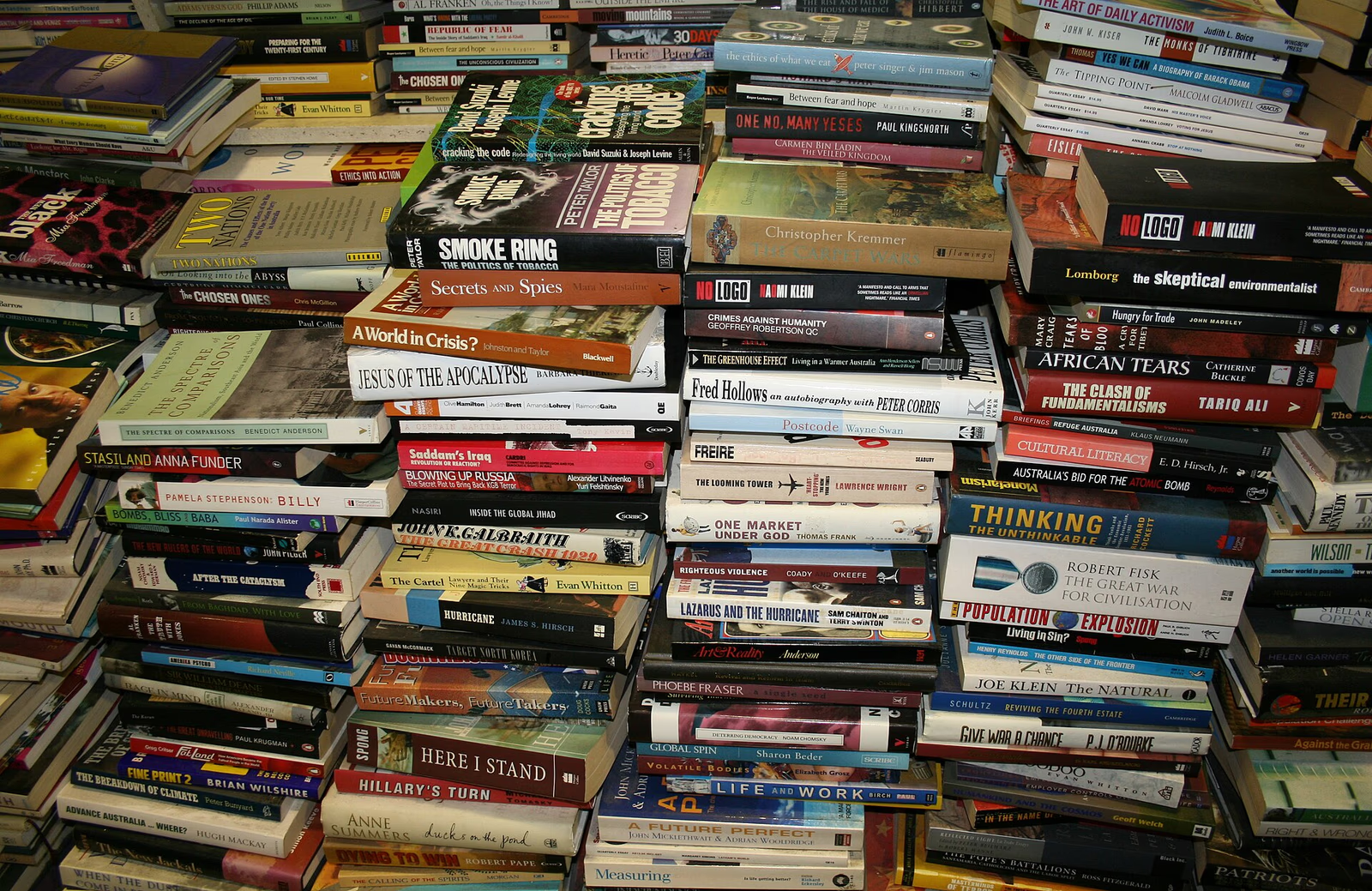
Photo: Toby Hudson — CC BY-SA 3.0, via Wikimedia Commons.
How to Actually Read a Photography Book
Read the pictures first, all the way through, without reading a word. Then go back and read the text. A book that fails the first pass is unlikely to reward the second.
Keep notes on the specific things you would steal: a lighting setup, a way of handling a background, a decision about how much to crop. General enthusiasm is not usable. A note that says "she lit this from behind through a doorway at roughly 45 degrees" is.
Front-load the technical books and back-load the monographs. Manuals give you vocabulary quickly. Bodies of work take years, and going back to a photographer you dismissed two years ago is one of the more reliable ways to notice that you have changed.
Tips for Building a Free Library
- Download public-domain books rather than only bookmarking them; links rot faster than files.
- Read a manual from fifty years before you were born. It shows you which problems are permanent.
- Keep a running note of exact techniques you want to try, not titles you found interesting.
- Prefer the archive catalogue record over the image alone. Photographer, date and format teach you as much as the frame.
- Watch for what the free collections do not contain. Most are heavy on expired copyright and thin on the last eighty years.
- Print one chapter if you are serious. It reads differently on paper, and that is not nostalgia.
Conclusion
The free shelf is deeper than most photographers realise. The public-domain manuals explain how composition and studio practice were reasoned about before anyone could lean on automation, and the open archives give you access to the same bodies of work that shaped the people who shaped the medium.
Use them in the order that suits you: a manual when you want a technique, an archive when you want to see how someone else solved a problem, and a monograph when you are trying to work out what you are actually doing with a camera. All three are free, and the only real cost is the time it takes to look properly.
The reason to read rather than skim is worth stating plainly. Editing tools are becoming smarter and more automatic every year, and the technical layer of photography is getting easier to fake. What cannot be automated is knowing where to stand. That knowledge is what the better photography books teach, and it is also why the oldest writing on the subject ages so well.
FAQ
Are these books really free to download?
The pre-1929 titles listed here have expired copyright in the United States and are typically available in full through Project Gutenberg, the Internet Archive and similar open collections. Later twentieth-century titles are usually still in copyright and are often available to borrow digitally rather than download. Check the terms on whichever platform you use before redistributing anything.
Where is the best single place to start?
Project Gutenberg or the Internet Archive for complete public-domain texts, and Library of Congress or The Met for images. Start with one archive and learn how it is organised rather than spreading yourself across ten.
Do nineteenth-century photography manuals still apply?
For composition, lighting logic, posing and the ethics of photographing people, yes, remarkably well. For chemistry, printing and equipment, treat them as history.
Why are there no recent bestsellers in this list?
Because recent books are still in copyright, and a list of free resources cannot include them. Open Library lets you borrow many of them, which is a better arrangement than pretending they are downloadable.
How do I avoid wasting time on free material?
Read the pictures first, and abandon anything that does not hold your attention on that pass. Give a technical manual an hour and a monograph an afternoon, and note down specific techniques rather than general impressions.
What about free material published online rather than as books?
The tutorial archives and essay sites in the third group function as a continuing book. They are free, constantly updated, and best searched by problem rather than read front to back.
Continue reading
AI-Generated Mockups Are Going Viral — But Are They Good for Fashion Brands?
May 24, 2026
Casual Going Out Fit: How Luxury Streetwear Is Redefining After-Dark Dressing
May 25, 2026
Ryan McGinley's Top Tips for Taking Stylish Travel Photos
September 27, 2026
Is AI Antithetical to Luxury? What Prada's Controversial Campaign Reveals About Fashion's Biggest Tension
May 24, 2026
Instagram Stars Share Their Secrets to Taking Amazing Photos
September 27, 2026
Working With Roxanne Lowit, the Queen of Backstage Photography
September 27, 2026
27 Flattering Portrait Poses
September 25, 2026
How AI Is Improving Digital Cameras
May 24, 2026
How to Pose and Photograph Shy, Difficult, or Anxious Pets
September 25, 2026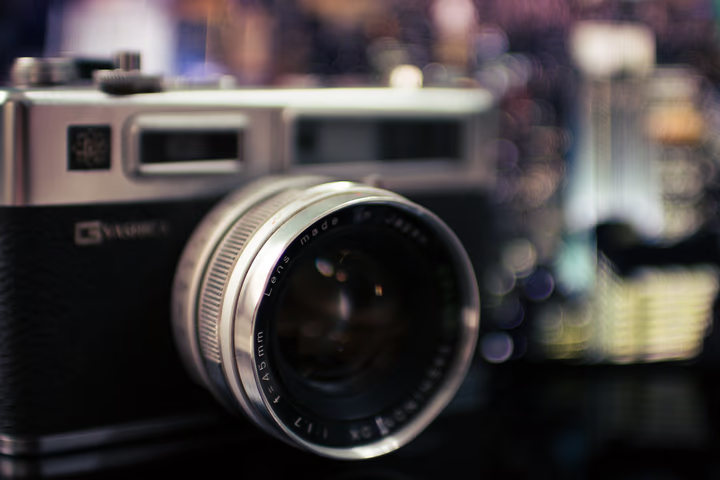
How to Format an SD Card on a Mac
May 24, 2026
How to Photograph Children: 29 Tips for Creative and Fun Photos
May 24, 2026
Everything to Know About Wedding Photography Styles
September 27, 2026
8 Sibling Rivalry Poses That Turn Fights Into Epic Photoshoots
July 11, 2026
A French Woman Walks Into Nordstrom — 33 Items She's Buying From the Half-Yearly Sale
May 24, 2026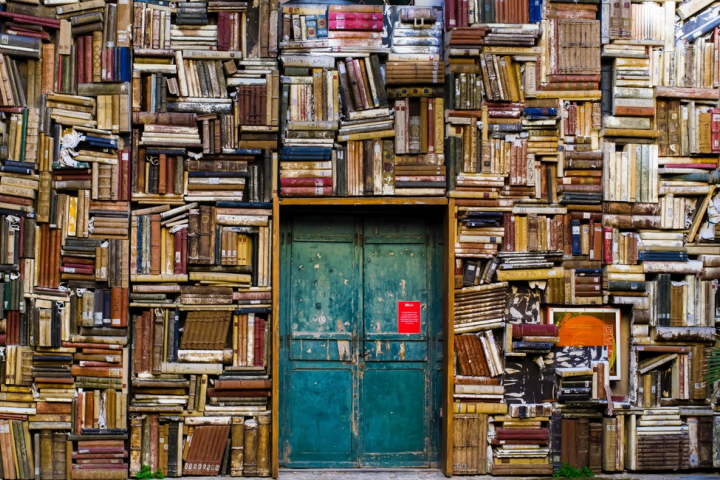
61 Best Photography Books for All Levels
September 25, 2026